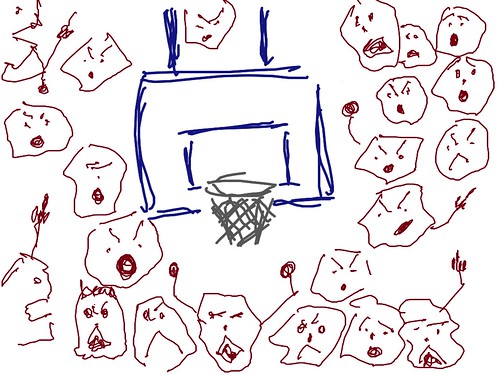
It's a funny coincidence that today I picked up a free copy of the The Wall Street Journal and it had an article on executive bonuses. Huge expensive carrots that, according to the experiments above, lead to less ability to deal with complexity.


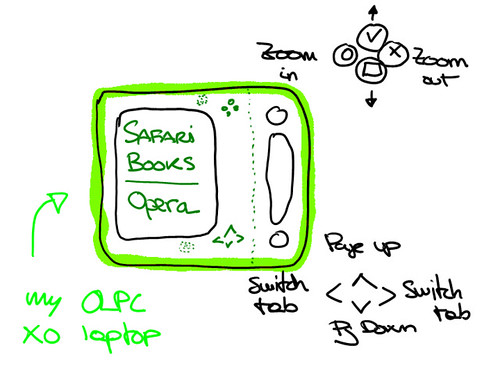
| Button | New value | Application/Browser |
| o (PageUp) | Zoom in,10 | Browser Widget |
| x (PageDown) | Zoom out,10 | Browser Widget |
| [] (Home) | Scroll down | Browser Widget |
| v (End) | Scroll up | Browser Widget |
| Up | Page up | Browser Widget |
| Down | Page down | Browser Widget |
| Left | Switch to previous page | Application |
| Right | Switch to next page | Application |
Continuous change is comfortable change. The past is then the guide to the future. An American friend, visiting Britain and Europe for the first time, wondered, "Why is it that over here whenever I ask the reason for anything, any institution or ceremony or set of rules, they always give me an historical answer, 'because'; whereas in my country we always want a functional answer, 'in order to'. Europeans, I suggested, look backward to the best of their history and change as little as they can; Americans look forward and want to change as much as they may.

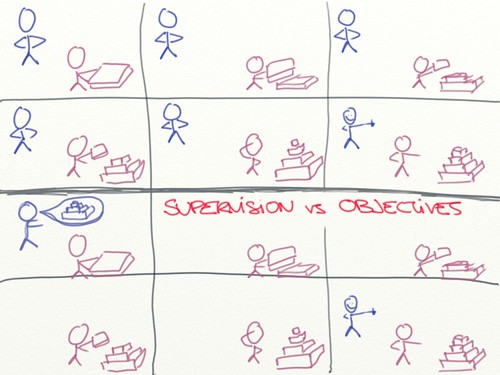
Drucker later elaborated on the setting of objectives in Managing by Results and many have considered this to be his most important contribution to management thinking. He shifted the focus of management actions away from the inputs to the outputs. It was management by results rather than management by supervision.
(...) Management by Objectives can turn into management by targets and quotas, with workers spending more time chasing the numbers than doing the real work. (...) Drucker knew this. The measures had to measure what really mattered. What Drucker wanted was a workplace where workers were trusted to get on with the job without undue supervision, where they knew what was expected of them and were clear about how it would be measured and how they would be rewarded.

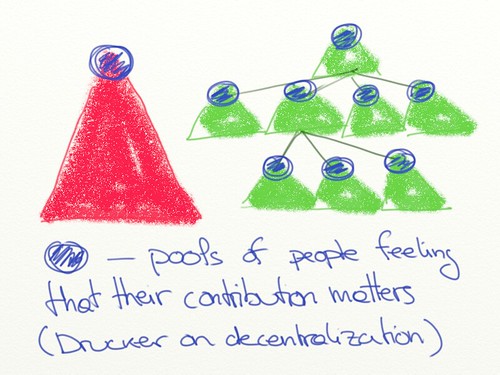
He explained, for the first time, how and why decentralization worked. He calculated that 95 per cent of all decisions in General motors at that time were taken by the divisions, leaving only the really big ones for the centre. Drucker was keen on decentralization because of its impact on what he called Human Effort, the motivation it provided to people to work and to learn. Decentralization created small pools where people felt that their contribution mattered. Those small pools also meant that there was space for young executives to make mistakes without threatening the future of the company. They were, he said, farms for growing talent.
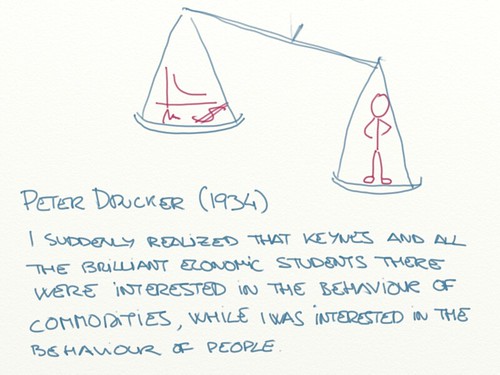
I suddenly realized that Keynes and all the brilliant economic students there were interested in the behaviour of commodities, while I was interested in the behaviour of people.
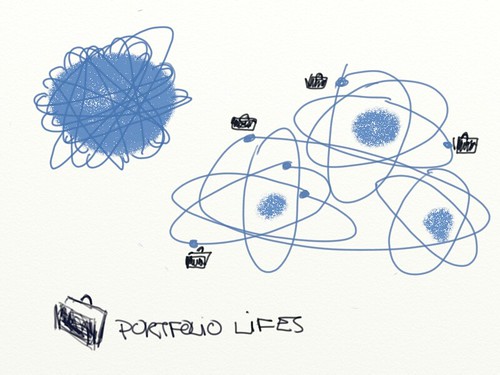
What interested me was not the downsizing or the re-engineering itself, but the consequences for our individual working lives. Organizations, it seemed to me, would increasingly dispense with our services in our mid-lives as they concentrated on fewer and younger people in their cores, with only a few wise heads to keep the show on track. The rest of us would have to develop what I called 'portfolio' lives, a mix of different bits and pieces of work, some for money, some for fun, some for free.

la aparición, en 1976, de la primera edición de mi obra clásica
esta década transcurrida ha provocado que mi cosecha intelectual y mi patrimonio científico se haya incrementado de forma destacada, con un buen número de artículos en revistas nacionales e internacionales de impacto científico, así como nuevos libros...
all forms of collective activity - politics, the family, as well as work - are about organizations in some way. Which also means - and it is a major failing of most books to ignore this - that to study organizations involves thinking about philosophy, politics, ethics and much more. And behind or beyond these abstractions are the lived experiences of people not just working together, but joking, arguing, critizing, fighting, deciding, lusting, despairing, creating, resisting, fearing, hoping or, in short, organizing. I don't find it easy to imagine a world without organizations, but I also don't find it easy to recognize that world in the mainstream books about organizations
Executive compensation has become a polite form of thievery, or, if you prefer, legal corruption. Executives get paid extra when the stock price goes up (bonus) and when it goes down (golden parachute); they get paid extra for staying in their job (retention bonus (...)), and for just doing their job (a bonus for signing a merger (...)).
As for the argument that if you don’t pay the bonuses, you don’t get the right person, I counter that if you do pay the bonuses, you get the wrong person. You get someone who is willing to single him or herself out from everyone else, at the expense of teamwork (...). The CEO, like everyone else in the company, has a job to do and should be paid for doing it. (...)
For the sake of sustainable enterprise: Executive bonuses should be eliminated. Period.
Once things have happened, no matter how accidentally, they will be regarded as manifestations of an unchangeable Higher Reason. For every argument inside government that some jerry-built bureaucratic arrangement should be changed, there are usually twenty arguments to show that it rest's on God's own Logic, an that tampering with it will bring down the heavens.

Has extret mai ADN d’un kiwi? Saps com Darwin va desenvolupar la seva teoria de l'evolució? Vols crear el teu propi fòssil? I... per a què serveix, en definitiva, la ciència?
Ara és la teva! Després de l'èxit de l'any passat la segona Jornada de Portes Obertes del PRBB et permetrà de nou respondre aquestes i altres preguntes, fer de científic per un dia passejant pels laboratoris i fent experiments reals.
Si mai us heu preguntat què s'hi fa dins d'aquest edifici de les fustetes que hi ha davant del mar, aquesta és la vostra oportunitat per esbrinar-ho.
Apropeu-vos-hi amb tota la família el proper dissabte 3 d'octubre. Hi haurà activitats per a petits i grans!

Scientists at Duke University Medical Center tested exercise against the drug Zoloft and found the ability of either -- or a combination of the two -- to reduce or eliminate symptoms were about the same. But they found exercise seemed to do a better job of keeping symptoms from coming back after the depression lifted.
(...) 8 percent of exercisers saw symptoms come back, compared with 38 percent of those taking drugs and 31 percent getting both.
The studies do not prove exercise relieves depression, in part because the exercisers worked out in a group, so group dynamics may have played a role
Nothing gets done here without someone somewhere getting enthused about an idea and then enthusing others.


Publi: Llama al xxxxx de Telefonica para lo que necesites; telefonos, direcciones, taxis, trafico, el tiempo, como llegar,... Fin publi SMS 900502020¿Saben mi móvil? Maniático de la privacidad, decido ponerme en contacto con la Agencia Española de Protección de Datos a través de su web:
He recibido de Telefónica un SMS de publicidad en mi teléfono móvil. Nunca he sido cliente de Telefónica con ese número. La única relación que ese número ha tenido con ellos es que una vez lo di como teléfono de contacto para una avería en mi línea fija.Un mes después, recibo del Jefe del Área de Atención al Ciudadano la respuesta que transcribo a continuación y que no me parece especialmente útil para decidir cuáles han de ser mis siguientes pasos. Eso si, el Jefe de Área me saluda atentamente, lo que le agradezco. Game over.
¿Es esto legal? Gracias.
En relación a su consulta se le informa de lo siguiente:
La legislación vigente en materia de protección de datos (Ley Orgánica 15/1999), reconoce una serie de derechos a los ciudadanos, como son el derecho de acceso, rectificación y cancelación de sus datos personales. El ejercicio de los mismos es personalísimo, y debe, por tanto, ser ejercido directamente por los interesados ante cada uno de los responsables/titulares de los ficheros automatizados, (salvo en el caso de menores de edad o incapacitados o salvo poder expreso y por escrito del titular de los datos y fotocopia de los dos DNI) lo que significa que el titular de los datos puede dirigirse a cada una de las empresas u organismos públicos, de los que sabe o presume que tienen sus datos, solicitando información sobre qué datos tienen y cómo los han obtenido (derecho de acceso), la rectificación de los mismos, la cancelación de los datos en sus ficheros (derecho de cancelación) o la oposición a que traten sus datos para un uso o fin determinado (derecho de oposición). En este caso, deberá dirigirse directamente al responsable del fichero en donde se encuentren sus datos personales, utilizando cualquier medio que permita acreditar el envío y la recogida de su solicitud, para el ejercicio de sus derechos, acompañando copia de su D.N.I. e indicando el fichero o ficheros a consultar.
La Agencia Española de Protección de Datos no dispone de los datos de los ciudadanos.
Si en el plazo de un mes para el derecho de acceso (y diez días hábiles en el resto de los derechos) desde la recepción de la solicitud en la sede del responsable del fichero, ésta no ha sido atendida adecuadamente, podrá dirigirse a la Agencia con copia de la solicitud cursada y de la contestación recibida (si existiera), para que ésta Agencia, a su vez, se dirija a la empresa designada con el objetivo de hacer efectivo el ejercicio de sus derechos.
El derecho de acceso no puede ejercitarse a intervalos inferiores a 12 meses, salvo que exista un interés legitimo al efecto (articulo 15.3 de la LOPD).


But remember, the brick walls are there for a reason.
The brick walls are not there to keep us out.
The brick walls are there to give us a chance to show how badly we want something.
Because the brick walls are there to stop the people who don't want it badly enough.
They're there to stop the other people.
sunlight is said to be the best of disinfectants
in the face of doubt, openness prevailsLots and lots of organizations, both corporations and public administrations, could learn from these quotes. Taken from a memo by Barack Obama for the heads of executive departments and agencies. I bet that my honeymoon phase will be over sooner or later... but, in the meanwhile, would you dear lucky Americans mind cloning several hundred POTUS and sending them all over the place?
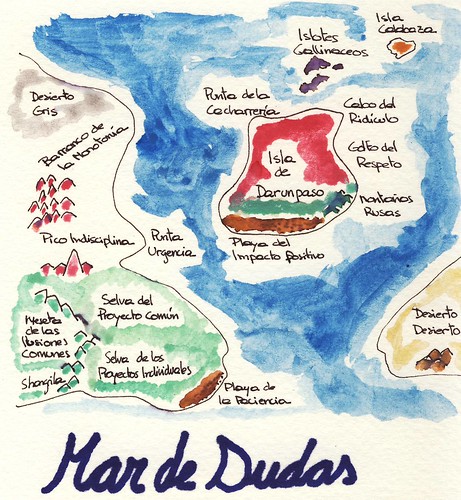
Este es uno de los 287 mapas que el Almirante Salomon Dudas dibujó intentando describir la cambiante geografía del mar que lleva su nombre.
De Wikipedia:
El Mar de Dudas fue descubierto por Sir Salomon Dudas durante su última expedición. Su ubicación exacta permanece deconocida, puesto que el cuaderno de bitácora de Dudas sólo contenía interminables ensayos sobre cuál era el mejor tipo de letra para detallar con claridad la ruta. Se tiene muy poca información sobre la última expedición de Dudas y su final. La única documentación disponible son los 287 mapas, el inútil cuaderno de bitácora y el diario personal del segundo de a bordo.
Después de ocho semanas explorando la zona, Dudas decidió volver a puerto. Dos días después, cambió de opinión y cambio ciento ochenta grados el rumbo, para hacerlo de nuevo tres veces más. Harta de este rumbo errático, la tripulación de Dudas se amotinó y le abandonó en un bote cerca de los Islas de Buridán. Mientras el HMS Zigzag se alejaba en un viaje de cuyo trágico final se desconocen los detalles, la tripulación pudo observar como Dudas remaba alternativamente hacia la Isla Norte y la Isla Sur, cayendo exhausto antes de alcanzar ninguna de las dos.
dn := @Subset(@DbName; 1);
linkType:= "Document";
nsfPath := @WebDbName;
qualifiedHost := @If(@Length(dn) = 0; ""; @DbLookup("":""; dn:"names.nsf"; "($ServersLookup)"; dn; "SMTPFullHostDomain"));
dbUrl := "Notes://" + qualifiedHost+ "/" + nsfPath;
viewUrl := dbUrl + "/";
docUrl := viewUrl + "/" + @Text(@DocumentUniqueID);
docTitle := @If(@IsAvailable(Subject);Subject;@IsAvailable(Title);Title;@IsAvailable(FullName);FullName;@Name([CN];@Author));
clipboardTxt := "[[" + docTitle + "|" + docUrl + "]]";
@Prompt([OkCancelEdit]; "TiddlyWiki link"; "Copy the text below to the clipboard."; clipboardTxt)
Eric Hanushek, an economist at Stanford, estimates that the students of a very bad teacher will learn, on average, half a year’s worth of material in one school year. The students in the class of a very good teacher will learn a year and a half’s worth of material. That difference amounts to a year’s worth of learning in a single year.It's a good article, focused on how hard is to predict new hires performance in some fields.
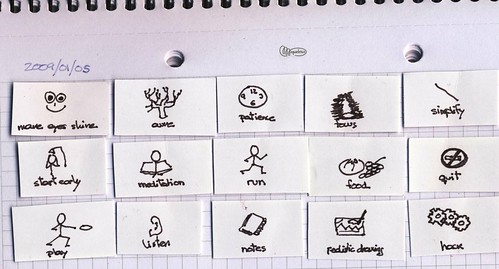
A first draft of my 2009 resolutions/guidelines. Inspired by Sacha Chua.
make eyes shine, awe, patience, focus, simplify
start early, meditation, run, food, quit
play, listen, notes, realistic drawing, hack

Sr. Vergés,Que durin!
Com a responsable del centre de la secció de videojocs, sento el malentés que hi ha hagut amb aquest joc. Fins fa ben poc, el PVP recomanat de l’article que vosté va adquirir era 39,90 €, i malauradament el fabricant no ens va comunicar la baixada de preu dels articles a 29,90€, d’aquí l’error.
El convido a que es passi per la botiga per a que li retornem la diferencia, amb el nostre “preu mínim garantit”, i aprofito per saludarlo atentament,