Mostrando entradas con la etiqueta leadership. Mostrar todas las entradas

2009/11/09

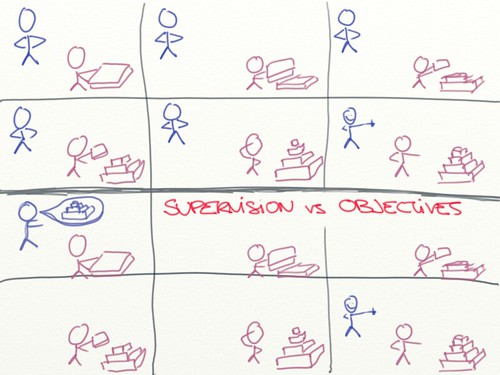
Peter Drucker: from supervision to objectives

Last post about the episode about Peter Drucker in The Handy Guide to the Gurus of Management.
Peter Drucker: from supervision to objectives

Drucker later elaborated on the setting of objectives in Managing by Results and many have considered this to be his most important contribution to management thinking. He shifted the focus of management actions away from the inputs to the outputs. It was management by results rather than management by supervision.

(...) Management by Objectives can turn into management by targets and quotas, with workers spending more time chasing the numbers than doing the real work. (...) Drucker knew this. The measures had to measure what really mattered.
What Drucker wanted was a workplace where workers were trusted to get on with the job without undue supervision, where they knew what was expected of them and were clear about how it would be measured and how they would be rewarded.

2009/01/28

Could someone please clone that man?

sunlight is said to be the best of disinfectants
in the face of doubt, openness prevails
Lots and lots of organizations, both corporations and public administrations, could learn from these quotes. Taken from a memo by Barack Obama for the heads of executive departments and agencies. I bet that my honeymoon phase will be over sooner or later... but, in the meanwhile, would you dear lucky Americans mind cloning several hundred POTUS and sending them all over the place?

Yay for transparency!

2008/05/01

Back in the U.S.S.R.


East Germany may no longer exist, but now we have companies featuring central planning by Troikas, mission statements crafted by apparatchiks, quinquennial planning, no right to choose leaders in companies, no democracy in the workplace, a clear distinction between intelligentsia and peasants (top CEOs make 512 times the median salary and enjoy company 'dachas', jets and limos), and 'state' monitoring (time clocks, dress codes, drug-screening, 'employee assistance' plans, e-mail monitoring, smoking and personal conduct rules, as family-life audits). [1]
This is not a quote from a labor union leader, an anti-globalization essay or a witty comedian. It's from a proponent of democracy and transparency in the workplace that happens to be a business owner putting his money where his unconventional mouth is [2]: Ricardo Semler, in The Seven-Day Weekend [3].

I loved this book, even if its writing style is not that great. Its main point is showing how Semco, Semler's company is run. When Semler and Clovis Bojikian started changing the traditional command and control ways,
"We wanted to demonstrate that the workplace could be a place of satisfaction, not of suffering. Work should be a pleasure, not an obligation. But this wasn’t just some humanitarian thesis. We believed that people working with pleasure could be much more productive.”
To Semler, it's not about values: it's about competitive advantage.

Hurry up and read his book, or take a peek into The Semco Way by reading a 1989 article by Semler in the Harvard Business Review or a 2006 article about him in Strategy+Business. I'm sure that it will give you lots of food for thought.

[1] Soviet/Corpororate parallels quote: It's a funny coincidence that I read this during International Workers' Day
[2] Unconventional mouth quote: by Geoffrey Colvin in a Fortune article
[3] Even if Semler is a best selling author, I never heard about him until I recently read a post by Jon Lister. Thanks so much, Jon!

2007/09/11

Virtual gaming, leadership and agile software development

Report cover
As I was reading the excellent Virtual Worlds, Real Leaders by seriosity and IBM's Global Innovation Outlook (GIO) team, I was struck with the similarities of the leadership attributes that they found in MMORPGs (Massively multiplayer online role-playing games) and those that are familiar to me from working in agile software development projects.

I'm quoting two summaries that appear in the report:

Online gaming environments facilitate leadership through:
1. Project-oriented organization
2. Multiple real-time sources of information upon which to make decisions
3. Transparent skills and competencies among co-players
4. Transparent incentive systems
5. Multiple and purpose-specific communications mediums
In fast moving distributed environments, leadership can be:
1. A temporary phenomenon
2. Task-oriented
3. Dynamic and constantly changing

Doesn't this make you think about how the daily scrum/stand up meeting and collective code ownership provides "transparent skills and competencies among co-players"? About how the leading roles in an agile team changes constantly among team members depending on the task at hand? About the fluid communications in the noisy room where the team is sitting?