Mostrando entradas con la etiqueta ibm. Mostrar todas las entradas

2009/11/13

Changes

Changes, changes, changes... Please, do not tell my mum about them, because she would be very upset with me!


Last July I took a two years leave from IBM. In a very smart move (in my opinion), IBM is paying me a third of my salary during a period that is forecasted to be of low business. I am allowed to work (and I need to!), but, obviously, I cannot work for IBM's competitors. They are investing this money to get a re-energized employee or, if the employee doesn't go back, to have him leave without having to lay him off, saving quite a bit of money.

I plan to take advantage of this by doing lots of learning and following some long time interests that I was performing on top of my formal role of at IBM: dealing/trying to make sense of organizations and teaching.

So what have I being doing during this months? Besides lots of reading and learning, Ganyet, Banzy and I toyed with the idea of working together in super-secret super-cool project, but, after a few weeks, I did not find a way to fit my skills into their needs; it is a pity, because world domination is in their road map.

When I left university, I should have made a project to become officially an engineer. I then joined IBM, and I was not disciplined enough to spend my free time finishing the project that I just started before joining. Almost 20 years later, I'm fixing that. And I'm very excited about it, because my project is about the software that should help to build a community around 1x1microcredit.org, a peer-to-peer micro-lending website that will offers people the possibility to lend money at low interest rates to poor people so that they can escape poverty, just like kiva.org. PHP aside, I feel very lucky for being able to work in a project that is technically cool and has an even cooler goal.
2008/12/03

Macacos

Ayer envié esto, en relación a mi actuación como enlace con el equipo de soporte de un producto del que no sé casi nada, en la que últimamente me limito a esperar órdenes de gente que está en una zona horaria equivocada:

Entiendo que el problema está en un punto en el que yo aporto poco más que un macaco al teclado
Si hay suerte, hoy le pasaré los trastos a un chimpancé y podré dedicarme a cosas más interesantes. Deberé enseñarle a Pobre Chimpancé algunas cosas que he aprendido cuando he sido yo el que daba soporte:
  • que hay que ser paciente y no irritarse cuando te preguntan por séptima vez la misma cosa: no es nada personal.
  • que entre lo que digan los logs y lo que digas tú, soporte no dudará en creer lo que dicen los logs. Y te preguntarán una octava vez.
¡Oh, queridos ex-clientes! ¡Estos días he comprendido a qué torturas os he sometido durante tantos años!

2008/11/30

Exhibición impúdica

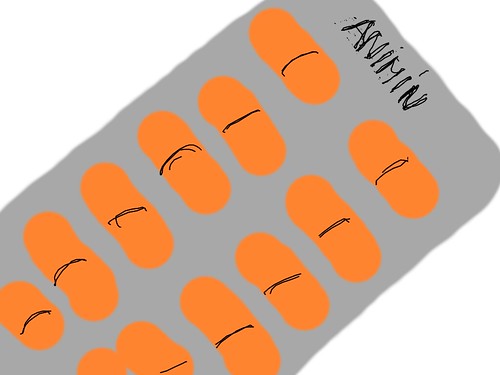
Esta semana me han dado varias pastillas de Egolín en forma de cosas agradables sobre mi que alguien le ha dicho a otra persona. Y, con toda la inmodestia, las transcribo

  • Tu padre mola. Se lo ha dicho a G. un compañero de cole, supongo que sorprendido de que un adulto recuerde que tiene piernas y las use para hacer carreras por el parque.
  • Xavier's assistance on this issue was most appreciated, en relación a una actuación de bombero en un cliente.
  • Xavier a fait un excellent travail en décrivant les étapes du project (...) Xavier est un excellent professionnel.
Y como, a pesar de un buen principio, no ha sido una semana brillante en todos los frentes, ¡no me ha ido mal enterarme!

Actualización: aunque esta me la han dicho directamente, también ha sido una deliciosa pastilla de Egolín: Una de las primeras personas a las que acudo cuando tengo problemas de código y me quedo bloqueado. Y una de las más desinteresadas y resolutivas. Gracias.

Pastillas naranjas

2008/11/19

ABCs of z/OS System Programming

One of the side effects of my recent research has been to learn that the famous ABCs of System Programming redbooks have been updated and have gone from 5 volumes to... 11!!

I've been browsing Volume 6: Security on z/OS, RACF, and LDAP. Kerberos and PKI. Cryptography and EIM. and it has been quite useful (though, in fact, it did not point me where I needed to go). Not all the volumes have been published as today. The pages for all the volumes list them all.

Certificate-based logon to zOS

DCAS (zOS Communications Server's Digital Certificate Access Server) has come to my rescue. From the docs:

The DCAS can be used by providers of logon and single sign-on services where access to z/OS-based applications is needed. The DCAS is a TCP/IP server that enables clients to connect over the network and obtain a passticket and z/OS user ID from RACF.

Clients that connect to DCAS must use the SSL protocol (DCAS supports SSL Version 3). Client authentication is performed.

Clients can request a user ID and passticket for an application. The client sends an x.509 certificate. DCAS converts the x.509 certificate to a valid user ID, which is returned. The x.509 certificate must have been mapped to a valid user ID in RACF
It's the second time in a few months that DCAS is the solution to the problem that I'm working on; unfortunately, I had forgotten about the first time, so it has taken my a while to get rescued. Not a complete waste of time: if learned a few things about PKI and RACF.

The first time it was about a service to generate passtickets (strings that can be used as passwords for a short while). Despite my recommendation, the customer's choice was to not use DCAS and code it from scratch; go figure.

Now it is about authenticating to RACF from a application that uses a smartcard reader. I'm looking forward to code the smartcard-based RACF logon, since working with smartcards has been in my wish list for very long.

And since google and DCAS don't seem to be big friends, I'm posting this.

2008/11/08

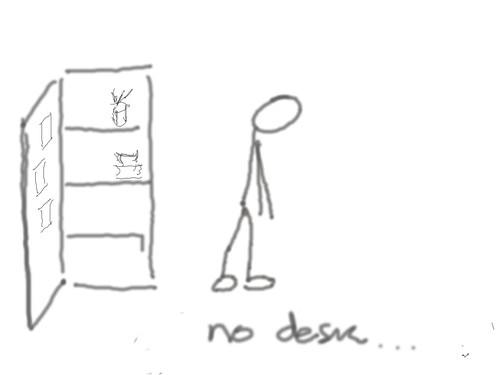
Got no desk :-(


Got no desk :-(, originally uploaded by -Xv.

My very own ibm desk is gone... No place to hang C's drawings, to keep my pencils (I really just care about the one that was a present from C.), the books I'm reading... I'll also miss sitting by my former team mates after so many years...

But I really cannot complain: I'm working very often from home now, so it makes little business sense to have a dedicated empty desk at the office.

2008/08/09

Verbose business cards

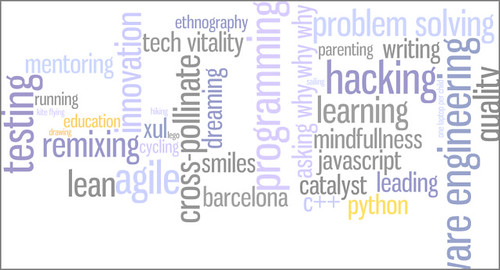
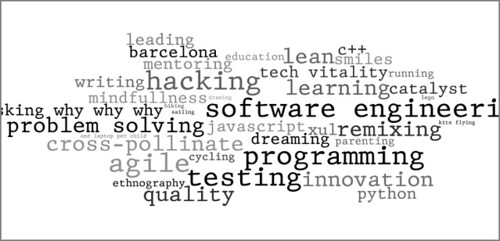
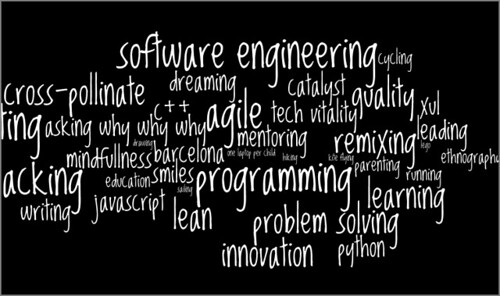
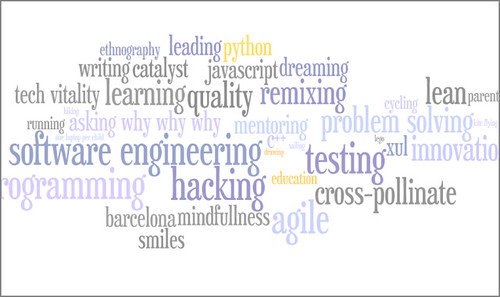
Learned from Kellypuffs that linkedin users can get 50 free MOO cards. Enter Jonathan Feinberg's Wordle (and a bit of javascript).


2008/05/15

Children are viruses

I'd love to run without anti-virus and anti-spyware, but children (especially teenagers) are incredibly adept at filling any PC with trojans and viruses in a matter of minutes. They even know how to bypass most internet filter software. I sometimes think children are viruses!

Seen on a comment on a Coding Horror post about the performance hit of antivirus software (what we really need is Anti-Anti-Virus software to keep us safe from the ongoing Anti-Virus software pandemic).

Ory Segal (an IBMer after watchfire's acquisition) also "celebrates" 20 years of anti-virus software.

2007/10/30

SiSi (Say It Sign It): Voice to Sign Language


Ain't that cool? I hope it goes past the demo stage in a near future!
Interesting info and links in a post by Laura Cowen.

2007/10/06

Jazz in the hood

Jazz band playing
Martin Espinach, coffee machine and lunch mate, gave yesterday a very nice internal talk about how his previous project used bugzilla and Mylyn to help them plan, assign and track team tasks. Although they were initially excited about Mylyn's task-focused UI, none of the team members ended up using it; they did love Mylyn's ability to get notifications from bugzilla. It looked like a neat solution.

When his very detailed talk was almost done, he told us that, for their recently started new project, they are using IBM Rational Jazz. I felt like killing him, but I then I would have missed the chance to complain about his talk during every afternoon coffee in the next weeks.

And Jazz? So far, they are loving it. I'll have to ask him to demo it to our team.

2007/05/16

Coding Contest in Second Life

Just good an email from Christoph Steindl, a former IBM colleague, where he used to co-lead the Agile@IBM community and write an excellent blog.

Are you familiar with the Coding Wars in Tom DeMarco and Tim Lister's Peopleware? Christoph is into something similar: the cool Catalysts' Coding Contest (CCC) that his company is running:

  • Who is faster? Who is more efficient? Who is more effective? Who is more productive?
  • Does "Pair Programming" really make you faster?
  • Does "Test-Driven Development" really lead to fewer bugs?
  • How many ways are there to solve a problem?
  • Is it right that good developers only write 30 lines of code for which mediocre developers need to write 300 lines?
Catalysts organizes a coding contest to go further into some of these questions.
They will be running the contest in Linz, Austria (with post food and beverages) and in Second Life (do avatars drink and eat?).

Looks like a bright idea to me. I bet that having participants with different backgrounds, and letting anonymous participation will provide coders and organizers useful insight. I don't know if other companies do this sort of thing internally, but it looks like very interesting way to get information, a honest measurement not linked to rewards and punishments (note to self: bring this to IBM's internal ThinkPlace).

I'm even considering ignoring my usual too-busy-with-real-life-to-get-me-a-second-life to be able to participate via Second Life.

2007/05/15

Disappointed by "The No Asshole Rule"


Not that I'm disappointed by the concept of having zero-tolerance attitude towards assholes, but by Bob Sutton's book on it: The No Asshole Rule: Building a Civilised Workplace and Surviving One That Isn't. The back cover promised hilarious examples in a funny, defiant little book. An enjoyable review by Guy Kawasaki and lots of good ratings in Amazon also made it look like a good read. And I have this dear friend working at Jerk Avenue, and I sort of hoped getting something for her. But the book, aside from making me take a little time to reflect a bit about my own episodes as an asshole [1][2], was just boring.

Maybe the problem is that before the first page I was already in agreement with the author, and I did not need the additional 170 pages. Or that I'm lucky enough of not having had to deal with assholes at work in quite a while. Or that I'm not involved in hiring any team. Or that I'm not a certified asshole.

Bob Sutton has done a very nice service making explicit the No Asshole Rule [3] and bringing focus to it. But I just did not need that many asshole stories and that much evidence about its virtues.

[1] A surprising book in improving my self asshole-ness awareness was Leadership and Self-deception: Getting Out of the Box (link for IBMers). I'm pasting a comment I made on Roo Reynolds blog, who said about it, "it made me think about the nature of selfishness. Not every book does that":

Your minimalist recommendation has made me read Leadership and Self-Deception: Getting Out of the Box . Thanks for that. I liked the storytelling approach, and, as "advertised" by you, it is really making me think. A lot.

My 2c for anyone else feeling tempted by the book: it is a book for anyone dealing with humans, no matter if the leadership stuff has any appeal to you.
[2] All this writing about my asshole-ness may convey the impression that I'm a jerk. My mum and I think that I'm quite nice. But the asshole path is always there...
[3] If you want the No Asshole Rule enforced, you can vote for Kellypuffs if you ever find that she is running for some election.

2007/04/28

Democratizing visualization

I learned today about IBM Research's Many Eyes, available at alphaWorks. Although at first sight it seems simply a nice tool to create nice visualizations, its goal is to enable collaboration around visualizations.

In Fernanda B. Viégas' words, the intend is "to enable people to collectively reason about the trends and patterns they see on the vivid representations of data called visualizations", or "distributed data analysis and collaborative sensemaking".


How? You can upload data sets. You can create visualizations of them. You can discuss the visualizations, highlighting parts of them.

You are not sold into the power of good visualizations? Check out Hans Rosling's Debunking third-world myths with the best stats you’ve ever seen TEDTalk (aka No More Boring Data, as posted on youtube). Or play with a tool similar to the one that he uses in the presentation, at http://tools.google.com/gapminder.

And whatever you think about Many Eyes, Hans Rosling, logarithms or baseball, do go and check the improved TED site.

Update: It seems that Many Eyes is not the only project in this area. From an article by Fernanda and Martin Wattenberg,

We think that social data analysis is a lively area right now and we are not the only ones exploring this space - two other sites of note are Swivel and Data360. Each of the 3 sites has a different emphasis, but what we have in common is a belief that the web enables a new, social kind of data analysis; a type of statistical thinking that is both playful and serious.
Social Data Analysis. Nice term.

2007/03/30

Customer Satisfaction and future buying decisions

It has been shown that as many as 90 percent of departing customers said that they were "satisfied" immediately prior to their attrition! Contrary to long-held misconceptions, "customer satisfaction" is actually a good measure of "customers' rationalizations of their past buying decisions," but not highly predictive of future buying decisions.

As a consumer, I think that this matches my buying patterns.

The quote is from Transforming Performance Measurement, by Dean Spitzer, a nice book even/specially for someone (like me) that tends to hate measurements and metrics. Dean is senior researcher, consultant, and performance measurement thought leader in IBM Research.

2007/03/21

Play with ClearQuest and ClearCase without installing them

I've been playing with IBM Rational ClearQuest and ClearCase without doing any configuration. Cool. I'm hoping that we'll do the same for more IBM Rational products.

You can access a dW server with a tutorial environment setup using a Citrix client. Go to Trial: Rational ClearCase V7.0 (I just reported it, but, in case that you take the first tutorial, you'll see that the screenshots of the first part don't match the actual product: you'll have to "connect" instead of "login", and you better know that pat's password is pat and that she has the lead project role).

2007/03/13

On using dead chickens for problem determination

My friend Luis comes back to the office in state of shock. He has been at a client's, along with two people from two other supplier companies that will go unnamed.

They are trying to determine why an application with code from the three parties is crashing. Luis is amazed while the experts invoke the crashing code while turning over their heads a dead chicken clockwise, check the output of filemon and regmon, repeat the process turning the chicken counter-clockwise, and perform another half an hour of equally insightful tests. Based on the evidence collected while changing the chicken's turning speed, the experts conclude that's IBM's code fault and they want to rush to tell the customer about it.

Luis takes a while to digest these new problem determination techniques, and, when he is able to recover his ability to speak, suggests taking a look at the logs from Doctor Watson; the experts are amazed by the tool; the logs show that the dead-chicken-based finger pointing is very unlikely to be right.

The experts grab their huge flemon and regmon outputs, the drwtson32 logs and their dead chickens and leave. It takes us a while to get Luis back to unpuzzled mode.

2007/03/06

Hormigas artificiales

Las hormigas artificiales no son el último gadget que un snob atento necesita tener en casa (¿o si?). La vida artificial consiste en utilizar modelos de simulación para estudiar sistemas complejos. No es que yo sepa sobre esto, pero hoy me he acordado [1] de una conferencia fantástica sobre hormigas artificiales a la que asistí hace años.

Las hormigas simuladas son simplonas, como probablemente lo son las de carne y hueso (?): van a por comida, comen un poquito, y llevan el resto al hormiguero. Si encuentran en su camino a otra hormiga, procurando el bien de la colonia, le cuentan dónde han encontrado comida.

Pero, ¡ay!, no todas las hormigas son genéticamente iguales: algunas son de fiar, mientras que otras son unas mentirosas que engañan a sus compañeras para que no se zampen la comida que han encontrado; unas son crédulas, y otras desconfiadas; unas, trabajadoras, mientras que otras deberían haber nacido cigarras; algunas se olvidan de la posición de la comida más facilmente que otras... Mueren, y nacen nuevas hormigas con su propia carga genética que define su grado de actividad, memoria, escepticismo y tendencia a mentir.

Ponemos a nuestras hormiguitas en su hormiguero, definimos la cantidad de comida disponible y las dejamos vivir (?). Independientemente de la disponibilidad de comidad, con el paso del tiempo son mayoría las hormigas con mayor actividad y memoria: las perezosas y las desmemoriadas tienen más complicado comer y sobrevivir.

Cuando la comida es escasa, las hormigas compiten, y mentirosos y escépticos tienen mayor probabilidad de sobrevivir. Cuando la comida es abundante, mentirosos y escépticos desaparecen de la colonia.

Fascinado pensando en cómo de las interacciones de muchas cosas simples surgen cosas complejas, y sin saber encontrar una moraleja en relación a la falsedad y el escepticísmo de las hormigas, acabo ya para ver si ahora funciona esta webcam de un hormiguero...

[1] Esta conferencia, una de las mejores a las que he asistido en mi vida, la dió Manuel Alfonseca, de la Autónoma de Madrid, ex de IBM, y miembro émerito del Technical Experts Council de IBM. Hoy M. Alfonseca tenía una Carta al Director publicada en La Vanguardia, y ver su nombre me ha llenado la cabeza y este post de hormigas. En su carta, discute la afirmación de Arcadi Navarro en un artículo anterior: "solamente por la ignorancia o la práctica consumada del autoengaño pueden creerse compatibles el evolucionismo y el diseño inteligente".

[2] ¡Puaj! Hoy sufro un caso flagrante de tantas ganas de leer (¡e incluso de volver a la universdad!) y tan poco tiempo... Algunos links:

2007/02/16

Quick and Easily Done Mashups + SOA and web 2.0

QEDWiki, a mashup maker by IBM, has got a nice intro and demo on video. If you liked it, better keep an eye on the Emerging Technologies You Need to Know !

Mahups and Mashup makers are an obvious way to show the value of service orientation. As the video states, Web 2.0 puts a face on SOA.

(via Ferran Rodenas' SDLC blog)

2007/02/15

Intro to security on z/OS

I've just read a good article from the IBM Systems Journal: Security on z/OS: Comprehensive, current, and flexible. About 20 printed pages, from 2001, and written "at a high level, aimed at enterprise decision makers and application architects. The intent is to explain the comprehensive security componentry within z/OS and to show how these techniques and functions are exploited by modern distributed and Internet applications".

This is not mentioned in the article, but one thing that in the past has made me feel uneasy about z/OS security was the limited maximum password length (8 chars), giving a very small password-space by today's computing standards. No need to be concerned about this anymore: z/OS V1.8 supports RACF pass phrases from 14 to 100 characters in length.

I learned some neat things about the z/OS security capabilities that, as far as I know, are not available in other operating systems, e.g.

The article mentions that the SSL performance has dramatically increased: from 13 SSL handshakes per second in 1998 to 2,000 in 2001. Likely to be old data, but this talks about 11,000 SSL handshakes/second.

Another introductory article that I liked is Ensuring Security On IBM Mainframes. Shorter (10 pages), but was useful for me to get a basic understanding of RACF classes and profiles.

More security-related goodies comming with z/OS v1.9; dear to me with what is keeping me busy today are support for PKCS#11 and a Java API for RACF administration.