Mostrando entradas con la etiqueta books. Mostrar todas las entradas

2011/04/12

Are we unprofessional?

From Uncle Bob's Clean Code, discussing the pressures that professionals get to deliver unacceptable quality:

What if you were a doctor and had a patient who demanded that you stop all the silly hand-washing in preparation for surgery because it was taking too much time? Clearly the patient is the boss; and yet the doctor should absolutely refuse to comply. Why? Because the doctor knows more than the patient about the risks of disease and infection. It would be unprofessional for the doctor to comply with the patient.

Ouch! What a great metaphor! It really hurts, but it is also a brilliant invitation to get vocal when one needs to get vocal.

2010/11/09

Kids need to learn to make good choices

You know, kids learn to make good choices not by following directions but by making choices
I liked this sentence so much that I wanted to find out more about its author, Alfie Kohn. After reading several reviews, good and bad, at Amazon, I ended up ordering Unconditional Parenting and making worse the backlog of books on my table.

While skimming over its intro, I liked a fragment by Barbara Coloso, on teenagers whose parents complain 'he was such a good kid, so well behaved, so well mannered, so well dressed. Now look at him!':

From the time he was young, he dressed the way you told him to dress; he acted the way you told him to act; he said the things you told him to say. He's been listening to somebody else tell him what to do... He hasn't changed. He is still listening to somebody else tell him what to do. The problem is, it isn't you anymore; its his peers.

2010/10/05

I have been reading

I have not been posting in months, but I have been reading some books.

I have also added some watercolor-painted stick-figure icons to http://els.verg.es/xavier, that has links to some of the different pieces of my digital identity.

2010/02/19

Secretaries

Expect to see personal assistants whose primary job is to sift through information and eliminate unnecessary drains on high-powered knowledge workers' attention (perhaps we will call them "secretaries").
As far as I'm aware, we haven't reached that point yet, and most business still value more cost-cutting on support staff than having people waste their attention in business logistics. Does not look that diffused complexity is planning to go away any time soon.

2009/11/25

Using OLPC XO as an ebook reader for O’Reilly’s Safari Books Online

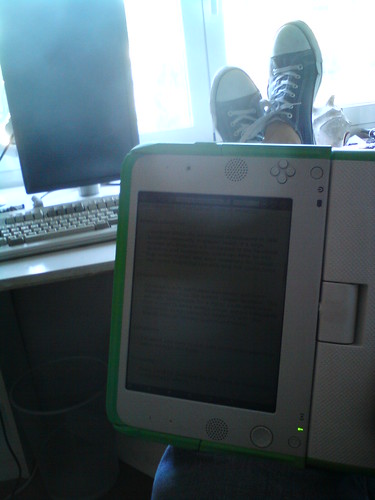
My XO OLPC is not collecting dust any more after I suddenly realized that its reflective screen mode would allow me to read safaribooksonline.com while outside. Firefox is an option, but I went for Opera. While connected, I open in different tabs the sections that I'm going to read; I then read in handheld mode, with wifi turned off to have a longer batery life.


My XO, my feet. my window, my IBM keyboard and my awesome monitor
  1. I updated my XO from how it came from the first edition of G1G1. The updated version is more friendly and privides a much longer battery life.
  2. Installed the old OLPC build of Opera.
  3. I tried to change (to no effect) the tiny tiny menu fonts (Tools -> Preferences -> Advanced Tab -> Fonts -> Interface Menu. Choose DejaVu serif, increase font to 16 and select bold for the weight. Setting the Interface menu font to anything greater than 16 causes menu text to become unreadable)
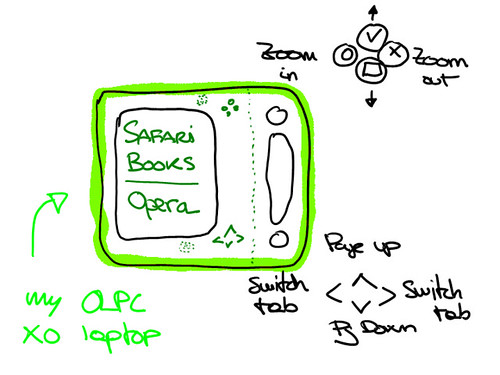
  4. I remapped the game pad buttons (more on this later)
  5. I went to http://www.safaribooksonline.com/interim/ that provides access to the mobile interface from non-mobile devices. Note the "interim" in the url: they did not allow this until recently, when a change from html to flash annoyed lots of customers; who knows for how long this will be available.

The arrow buttons in the game pad change whenever you change the screen orientation: up is always the one that points upwards. The playstation-like buttons do not change their function with the screen orientation.

Since all I want to do is read from already loaded tabs, these are the mappings that looked more comfortable for me. This other set would allow to use links and navigate.
Opera in handheld mode in my XO

ButtonNew valueApplication/Browser
o (PageUp)Zoom in,10Browser Widget
x (PageDown)Zoom out,10Browser Widget
[] (Home)Scroll downBrowser Widget
v (End)Scroll upBrowser Widget
UpPage upBrowser Widget
DownPage downBrowser Widget
LeftSwitch to previous pageApplication
RightSwitch to next pageApplication


To change the mappings, Tools -> Preferences -> Advanced Tab -> Shortcuts and edit the Keyboard setup named "Opera Standard for Unix"; you will be creating a modified version, and going back to the default one will be easy if needed. Search for them, and edit them with a double click, changing columns with the tab key. For the last two, you'll have to clear the search field, select the "Application" row and then click on "New..."

2009/10/30

El autor sin abuela y la teoría de la organización

La portada de la PDA gigante era un mal augurio. Si no fuera porque el material de la asignatura Organización y administración de empresas II, que curso en la UOC, está basado en gran parte en este libro, la PDA platillo volante habría sido suficiente para dejar el libro en la estantería de la biblioteca.


Pero, ¿qué importa una portada? Se trata de los contenido, y parezco estar en buenas manos. Al menos, el autor, Eduardo Bueno Campos, no tiene la menor duda de ello; de los prólogos de la primera y segunda edición extraigo las siguientes muestas
la aparición, en 1976, de la primera edición de mi obra clásica
esta década transcurrida ha provocado que mi cosecha intelectual y mi patrimonio científico se haya incrementado de forma destacada, con un buen número de artículos en revistas nacionales e internacionales de impacto científico, así como nuevos libros...
Pero leo y leo y, ¡ay! , no puedo compartir el entusiasmo del autor por el mismo autor. Y, básicamente, todo se reduce a que soy incapaz de relacionar mi percepción sobre las organizaciones con las que convivo o he convivido con la mayoría de cosas de las que me habla el libro. Capítulos enteros sin entender de dónde venía el texto (¿descripción de la realidad? ¿prescripción para mejores organizaciones? ¿alguna escuela de pensamiento reconocida? ¿el propio autor? ¿palabra revelada?).

Otro libro sobre teoría de la organización describe muy bien porque me interesa la teoría de la organización y por qué me decepciona no disfrutar leyendo o discutiendo sobre ella:
all forms of collective activity - politics, the family, as well as work - are about organizations in some way. Which also means - and it is a major failing of most books to ignore this - that to study organizations involves thinking about philosophy, politics, ethics and much more. And behind or beyond these abstractions are the lived experiences of people not just working together, but joking, arguing, critizing, fighting, deciding, lusting, despairing, creating, resisting, fearing, hoping or, in short, organizing. I don't find it easy to imagine a world without organizations, but I also don't find it easy to recognize that world in the mainstream books about organizations
He disfrutado de este segundo libro como de una novela, aunque a menudo he estado en desacuerdo con el autor Chris Grey. Otro día, más sobre el estupendo A Very Short Fairly Interesting and Reasonably Cheap Book About Studying Organizations.

2009/10/23

Comprant llibres

M'he convertit en un entusiasta de The Book Depository. Normalment hi comprava els llibres via amazon.fr; acostumaven a sortir-me una mica més barats que comprant-los a Amazon mateix. Ara els compro directament, amb enviament gratuït, i encara em surt una mica més barat.

amazon.com, però, segueix sent insustituible a l'hora de buscar opinions. I sempre intento començar llegint algunes de les opinions amb menys estrelles. Entre altres motius, per què em convé més que em convencin de no comprar un llibre que de fer-ho.

2009/05/17

Robinson Crusoe


ROBINSON CRUSOE. Una novela en imágenes inspirada en la obra de Daniel Defoe de Ajubel. Estupendo.

De la colección Libros para niños de la editorial valenciana Media Vaca. Como para gastarse una pequeña fortuna.

2008/09/27

La mujer del viajero en el tiempo


Sábado pegado al sillón por culpa de La mujer del viajero en el tiempo. de Audrey Niffenegger. No creo que esta haya sido la última vez que lo leo.

2008/05/01

Back in the U.S.S.R.


East Germany may no longer exist, but now we have companies featuring central planning by Troikas, mission statements crafted by apparatchiks, quinquennial planning, no right to choose leaders in companies, no democracy in the workplace, a clear distinction between intelligentsia and peasants (top CEOs make 512 times the median salary and enjoy company 'dachas', jets and limos), and 'state' monitoring (time clocks, dress codes, drug-screening, 'employee assistance' plans, e-mail monitoring, smoking and personal conduct rules, as family-life audits). [1]
This is not a quote from a labor union leader, an anti-globalization essay or a witty comedian. It's from a proponent of democracy and transparency in the workplace that happens to be a business owner putting his money where his unconventional mouth is [2]: Ricardo Semler, in The Seven-Day Weekend [3].

I loved this book, even if its writing style is not that great. Its main point is showing how Semco, Semler's company is run. When Semler and Clovis Bojikian started changing the traditional command and control ways,
"We wanted to demonstrate that the workplace could be a place of satisfaction, not of suffering. Work should be a pleasure, not an obligation. But this wasn’t just some humanitarian thesis. We believed that people working with pleasure could be much more productive.”
To Semler, it's not about values: it's about competitive advantage.

Hurry up and read his book, or take a peek into The Semco Way by reading a 1989 article by Semler in the Harvard Business Review or a 2006 article about him in Strategy+Business. I'm sure that it will give you lots of food for thought.

[1] Soviet/Corpororate parallels quote: It's a funny coincidence that I read this during International Workers' Day
[2] Unconventional mouth quote: by Geoffrey Colvin in a Fortune article
[3] Even if Semler is a best selling author, I never heard about him until I recently read a post by Jon Lister. Thanks so much, Jon!

2007/06/23

Llibres en anglès a Barcelona

Vinc d'Hibernian Books, a Gràcia; està la mar de bé i m'he firat un parell de llibres:

  • Applied Cryptography, de Bruce Schneier, per 7€
  • The Peter Principle, per 4€. M'ha fet molta il·lusió, doncs l'havia llegit en castellà fa una pila d'anys, però ja fa molt que no sé on para.
M'han parlat molt bé de Elephant Book Store.

2007/05/15

Disappointed by "The No Asshole Rule"


Not that I'm disappointed by the concept of having zero-tolerance attitude towards assholes, but by Bob Sutton's book on it: The No Asshole Rule: Building a Civilised Workplace and Surviving One That Isn't. The back cover promised hilarious examples in a funny, defiant little book. An enjoyable review by Guy Kawasaki and lots of good ratings in Amazon also made it look like a good read. And I have this dear friend working at Jerk Avenue, and I sort of hoped getting something for her. But the book, aside from making me take a little time to reflect a bit about my own episodes as an asshole [1][2], was just boring.

Maybe the problem is that before the first page I was already in agreement with the author, and I did not need the additional 170 pages. Or that I'm lucky enough of not having had to deal with assholes at work in quite a while. Or that I'm not involved in hiring any team. Or that I'm not a certified asshole.

Bob Sutton has done a very nice service making explicit the No Asshole Rule [3] and bringing focus to it. But I just did not need that many asshole stories and that much evidence about its virtues.

[1] A surprising book in improving my self asshole-ness awareness was Leadership and Self-deception: Getting Out of the Box (link for IBMers). I'm pasting a comment I made on Roo Reynolds blog, who said about it, "it made me think about the nature of selfishness. Not every book does that":

Your minimalist recommendation has made me read Leadership and Self-Deception: Getting Out of the Box . Thanks for that. I liked the storytelling approach, and, as "advertised" by you, it is really making me think. A lot.

My 2c for anyone else feeling tempted by the book: it is a book for anyone dealing with humans, no matter if the leadership stuff has any appeal to you.
[2] All this writing about my asshole-ness may convey the impression that I'm a jerk. My mum and I think that I'm quite nice. But the asshole path is always there...
[3] If you want the No Asshole Rule enforced, you can vote for Kellypuffs if you ever find that she is running for some election.

2007/04/28

La felicidad y la bola de cristal

A toda prisa a la librería de la esquina [1] a comprarme Tropezar con la felicidad, de Daniel Gilbert, después de haber escuchado su divertida y sorprendente conferencia en TED Talks.

La idea básica de la conferencia es que somos muy malos en nuestras predicciones sobre lo que nos hará felices o no. Al parecer, tenemos las mismas posibilidades de ser felices tanto consiguiendo lo que deseamos como no consiguiéndolo.

Está llena de datos sorprendentes, como que, un año después de acontecimientos tan distintos como quedar parapléjico o ganar la loteria, las personas de los dos grupos muestran el mismo nivel de felicidad. O que mayores posibilidades de elección van en detrimento de nuestra felicidad (más sobre esto en la también sorprendente conferencia de Barry Schwartz The paradox of choice).


[1] Mi librero no tiene el libro, así que lo encargo y me llevo uno de José Antonio Marina. JAM siempre me gusta. La magia de escribir, escrito con María de la Válgoma.

Curioso: ¿por qué me da esta pájara de comprarme libros sobre escritura (Bird by Bird, The War Of Art, La magia de escribir)?!

2007/03/26

La primera novel·la

La venganza de las Risitas (La venjança dels Mofetes) de Roddy Doyle va ser la primera novel·la que vaig llegir-li al meu fill. A tots dos ens va encantar. Passar dels contes a una novel·la va ser molt divertit pels dos: calia repassar on havíem deixat la historia la nit abans, i "calia" discutir cada nit per què ell sempre volia llegir un capítol més (i jo!).

Durant setmanes, les Risitas van formar part de les nostres bromes. Les Risitas són criatures que s'encarrguen de venjar-se del adults que li fan una injustícia algun nen (Las personas mayores que dicen que algo sabe a pollo cuando no es cierto, las que los culpan sabiendo que son inocentes, las que se comen el último trozo de pizza sin preguntar si a alguien le apetece más..).

Els dies que estic malcarat ja m'aniria prou bé que les Risitas no fossin personatges fantàstics i m'ajudessin a fer examen de consciència amb els seus recordatoris pringosos...

M'enduc una alegria en ensopegar a la biblioteca amb Rover salva la Navidad, que segueix amb els personatges de La Venganza de las Risitas. En G. (9 anys) no el deixa anar fins que se l'acaba; ja és un devora-llibres i queda molt lluny això de llegir junts (ara sovint llegeixo el que em recomana).

La C. (4 anys) és ara a la fase de voler cada dia el mateix conte, després de molt temps en que semblava que no tenia prou paciència per un conte sencer; estic content: trobava a faltar llegir-li!

I escrivint això tinc una nova alegria, doncs veig que hi ha un tercer llibre sobre la família Mack: Mientras tanto... una aventura. I tots tres magníficament il·lustrats per Brian Ajhar.

Actualització: En G. ha trobat boníssim el Rover salva la Navidad. Jo no tant.

2007/03/21

Book review

Seen on an Amazon book review:

This book is both original and good. The part that is good is not original and the part that is original is not good.
I loved it.

Update: it looks like this is often attributed to Samuel Johnson, but it seems that it is not found in any of his works.

Bird by bird


I've finished reading Bird by Bird: Some Instructions on Writing and Life, by Anne Lamott. I've enjoyed it more than anything that I have read in years. The book tries to capture what Lamott teached in her writing worshops, "every single thing I know about writing". And the surprising thing is that she does it in a way that makes the book great even for people like me that don't have the slightest interest in writing fiction [1].

Not every book makes you think, or gives you advice that sets you in a good mood that lasts for days, or makes you have bursts of laughter while reading it on the bus, or makes you feel like going to watch a baseball game when you have always thought that watching paint dry is more exciting than watching a baseball game. And Bird by Bird did all this to me.

I'll be quoting some instructions on life in other posts, but I feel like quoting today some of the fragments that have made me burst in laughter. Of course, sense of humor being sense of humor, they may not even make you smile.

On the writer's block (p177)

A blissfully productive manic stage may come to a screeching halt, and all of a sudden you realize you're Wile E. Coyote and you've run off the cliff and a second away from having to look down. (...) You may feel a little as if writing a novel is like trying to level Mount McKinley with a dentists drill.
On one of the reasons to write a book while her father was dying of cancer (p187)
I found myself desperate for books that talked about cancer in a way that would both illuminate the experience and make me laugh. But there weren't many. In fact, there was only one that I was aware of, Violet Weingarten's Intimations of Mortality, a journal of het chemotherapy (...) I read the book over and over (...), then went to the library and said, "Do you have any other really funny books about cancer?" And they looked at me like, Yeah, they're are right over there by the comedies about spina bifida.
While discussing the lack of books on single parenting that were funny and sick and therefore true (p188)
Having a baby is like suddenly getting the world's worst roommate, like having Janis Joplin with a bad hangover and PMS come to stay with you.
[1] During my teen years, I liked to write short stories; but in my late teens I thought that first I had to become a better reader before being a writer. And when I realized that, while enjoying very much reading, I was not able to capture in the books what other people seemed to be able to capture, I decided that I was done with writing fiction.

2007/02/12

e-ink

Jeff Berg [1], in his IBM intranet blog [2], commented days ago on having used a Sony Reader: 'astounded at how much it looked like paper'. Like a book, it is not back-lit: comfortable to read for long periods, but requiring external light.

It was the first time that I heard about Sony Reader, but now both my back and my brain would love to own this gadget.

[1] I don't know how to link to Jeff. Here you have a link to his Beginning ActionScript 2.0 book and to his wondeful video of a Chicago building being teared down.

[2] Jeff's "Fight For The User" blog is, by far, the most visually interesting in our intranet. And it's not just pretty: lots of good posts on usability and information design. He does indeed fight for the user.

Trascender nuestra tribu

En una entrevista a Lluís Magriñà, director del Servicio Jesuita a Refugiados en La Contra de La Vanguardia:

No hay libertad sin educación. Ser libre es trascender tu tribu. Por eso la democracia real hoy sólo es factible en los paises en los países donde se generaliza la ensenanza secundaria.
Lluís Amiguet, el entrevistador, escribe:
Magriñà nos trae de África algunas lecciones para nuestra democracia moderna y europea, empezando por que sólo somos libres si somos capaces de trascender nuestra tribu, nuestro clan y nuestro partido para elegir al más capaz de cualquier tribu, partido o clan, aunque no sea el nuestro, y dejar que sea él quien nos represente y gestione nuestro intereses.
La idea de Magriñà sobre la importancia de trascender la tribu me hace rebuscar unas notas de hace unas semanas sobre una entrevista en La Vanguardia a Arjun Appadurai (de pago), en la que hablaba de identidad cultural, globalización y conflicto. Algunos extractos:
Los estados nación están perdiendo capacidad, control sobre su economía, y hay una tendencia a enfatizar la esencia cultural. Incluso en la UE, la gente se pregunta que sucederá, por ejemplo, con la identidad italiana. Esta preocupación puede convertirse en patológica, extrema. Cuando esto sucede hay una búsqueda de un chivo expiatorio al que atacar. Pueden ser emigrantes o minorías internas.
(...)
Una minoría que se enfada es un objeto perfecto para el enfado de la mayoría. La frontera hacia el genocidio se da cuando las dos cosas se encuentran: una mayoría enfadada y una minoría enfadada. (...) En las banlieues parisinas, la mayoría todavía no está enfadada. O, al revés, en la India la mayoría está enfadada con Pakistán, pero los musulmanes indios, que son 120 millones entre más de 1.000, tratan de buscar la paz. Lo que sucedió en Yugoslavia o Ruanda tenía que ver con el enfado de minoría y mayorías.
(...)
La creación de la identidad francesa supuso empujar a otras como la bretona, que era muy fuerte. De ese modo, si no eres de la identidad mayoritaria, eres separatista, peligroso, antipatriótico. (...) Hoy, para ser independientes sólo pueden hacer una cosa: crear un Estado. En el cual volverán a chocar las pequeñas identidades. Para la identidad grande, el nacionalismo será una liberación, y, para las pequeñas, represión.
(...)
Cuando el contacto se hace más intenso, paradójicamente funciona lo que Freud llamaba el narcisismo de las pequeñas diferencias: aunque la gente sea casi igual, pequeñas diferencias se convierten en muy importantes.
(...)
La gente necesita identidades locales porque no vamos a ser sólo ciudadanos del mundo, pero hemos de crear constituciones sin el toque de etnia local. (...), pensar en nuestras identidades locales como en las de una asociación voluntaria, como si perteneciéramos a un club de fútbol, donde no importa de dónde vienes, sólo lo que quieres o te gusta. O como en los clásicos principios del Estado nación acentuar el aspecto geográfico, que es el más sano frente al racial o lingüístico.
Me resulta divertido que mencione clubs de fútbol y mayorías y minorías enfadadas. Toda mi vida he pensado que los patriotas son a menudo gente enfadada que parece levantarse por la mañana esperando descubrir la última afrenta que ha sufrido su patria. Y también llevo muchos años sorprendido de que el sentimiento patriótico no esté en el ámbito de lo privado, junto a la religión, tu equipo de fútbol o tus preferencias sexuales y de color de calcetines; en cambio, muchas veces este sentimiento es una parte central de la vida política.

La entrevista me ha dado muchas ganas de leer La Modernidad Desbordada (creo que la edición en español es inecontrable; Modernity at Large en amazon.co.uk) y Fear of Small Numbers: An Essay on the Geography of Anger. Y quizás también de regalárselos a algunos patriotas de distinto pelaje y patria que conozco.

Bonus link vagamente relacionado: Changes, animación estupenda (2 min 30 sec, youtube) sobre la identidad y la uniformidad. Via César Viteri en Multimaníaco, con comentarios interesantes sobre la gestión del cambio organizativo; a su vez, via Vida de un Consultor; a su vez, via...)