Mostrando entradas con la etiqueta charles-handy. Mostrar todas las entradas

2009/11/12

"because" vs "in order to"

Charles Handy, in The Age Of Unreason

Continuous change is comfortable change. The past is then the guide to the future. An American friend, visiting Britain and Europe for the first time, wondered, "Why is it that over here whenever I ask the reason for anything, any institution or ceremony or set of rules, they always give me an historical answer, 'because'; whereas in my country we always want a functional answer, 'in order to'. Europeans, I suggested, look backward to the best of their history and change as little as they can; Americans look forward and want to change as much as they may.

I'll keep an eye opened to see what answers I give to myself, and what answers I hear from other people. Being an in-order-to person looks to me like a very nice goal.
2009/11/09

Peter Drucker: from supervision to objectives

Last post about the episode about Peter Drucker in The Handy Guide to the Gurus of Management.

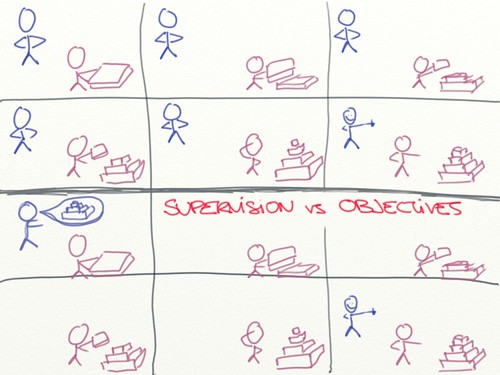
Peter Drucker: from supervision to objectives

Drucker later elaborated on the setting of objectives in Managing by Results and many have considered this to be his most important contribution to management thinking. He shifted the focus of management actions away from the inputs to the outputs. It was management by results rather than management by supervision.

(...) Management by Objectives can turn into management by targets and quotas, with workers spending more time chasing the numbers than doing the real work. (...) Drucker knew this. The measures had to measure what really mattered.
What Drucker wanted was a workplace where workers were trusted to get on with the job without undue supervision, where they knew what was expected of them and were clear about how it would be measured and how they would be rewarded.

2009/11/08

Peter Drucker on decentralization

Yet another post about the third episode in The Handy Guide to the Gurus of Management.
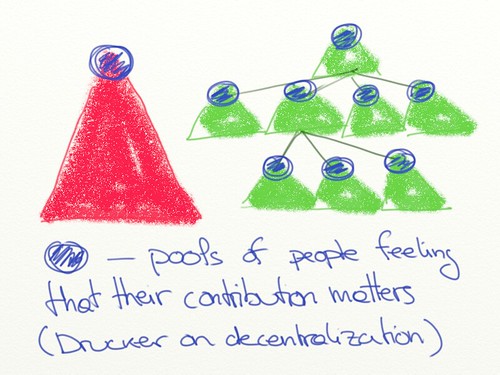
Peter Drucker on decentralization

He explained, for the first time, how and why decentralization worked. He calculated that 95 per cent of all decisions in General motors at that time were taken by the divisions, leaving only the really big ones for the centre. Drucker was keen on decentralization because of its impact on what he called Human Effort, the motivation it provided to people to work and to learn. Decentralization created small pools where people felt that their contribution mattered. Those small pools also meant that there was space for young executives to make mistakes without threatening the future of the company. They were, he said, farms for growing talent.

2009/11/04

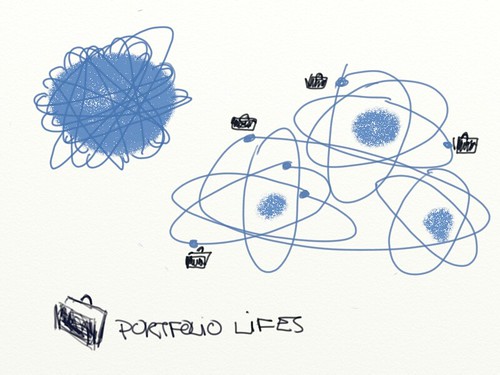
Charles Handy and Potfolio Lifes

What interested me was not the downsizing or the re-engineering itself, but the consequences for our individual working lives. Organizations, it seemed to me, would increasingly dispense with our services in our mid-lives as they concentrated on fewer and younger people in their cores, with only a few wise heads to keep the show on track. The rest of us would have to develop what I called 'portfolio' lives, a mix of different bits and pieces of work, some for money, some for fun, some for free.

Portfolio Lifes
That quote was from Charles Handy, in the second episode of his Handy Guide to the Gurus of Management, hardly about management, but about society.

2009/11/03

The Handy Guide to the Gurus of Management

From BBC's Learning English, The Handy Guide to the Gurus of Management, an old (2002?) and delightful audio series.


Do not miss it.

It is written and narrated by Charles Handy. Listening to Handy's voice is a pleasure. And it does not matter if you don't care about businesses or management: most of it is about society and some of the changes in our world during the last half century.

Each episode is less than 15 minutes long, and has a full transcript.