Mostrando entradas con la etiqueta .in-english. Mostrar todas las entradas

2011/04/12

Are we unprofessional?

From Uncle Bob's Clean Code, discussing the pressures that professionals get to deliver unacceptable quality:

What if you were a doctor and had a patient who demanded that you stop all the silly hand-washing in preparation for surgery because it was taking too much time? Clearly the patient is the boss; and yet the doctor should absolutely refuse to comply. Why? Because the doctor knows more than the patient about the risks of disease and infection. It would be unprofessional for the doctor to comply with the patient.

Ouch! What a great metaphor! It really hurts, but it is also a brilliant invitation to get vocal when one needs to get vocal.

2010/11/09

Kids need to learn to make good choices

You know, kids learn to make good choices not by following directions but by making choices
I liked this sentence so much that I wanted to find out more about its author, Alfie Kohn. After reading several reviews, good and bad, at Amazon, I ended up ordering Unconditional Parenting and making worse the backlog of books on my table.

While skimming over its intro, I liked a fragment by Barbara Coloso, on teenagers whose parents complain 'he was such a good kid, so well behaved, so well mannered, so well dressed. Now look at him!':

From the time he was young, he dressed the way you told him to dress; he acted the way you told him to act; he said the things you told him to say. He's been listening to somebody else tell him what to do... He hasn't changed. He is still listening to somebody else tell him what to do. The problem is, it isn't you anymore; its his peers.

2010/10/05

I have been reading

I have not been posting in months, but I have been reading some books.

I have also added some watercolor-painted stick-figure icons to http://els.verg.es/xavier, that has links to some of the different pieces of my digital identity.

2010/05/18

OpenID

I'm a happy new user of http://myopenid.com.
  • Registration was very simple
  • The OpenID urls you get are nice (yourchoice.myopenid.com)
  • It supports multiple personas, i.e. during the signon process, you can choose differents sets of personal information to share with the requesting site
  • You get a detailed account activity report
Out of laziness, I've been resisting for years to get a proper OpenID account. Sometimes I've been using the one provided with blogger.com; others, my Flickr photostream url. And then sometimes I've signed up to places using my google or twitter accounts. In fact, a site requesting access to my list of contacts during registration with my google account has been the trigger to take care of this.

Two html lines have allowed me to use a vanity url (http://els.verg.es/xavier) and to avoid getting married to myopenid.com

2010/02/19

Secretaries

Expect to see personal assistants whose primary job is to sift through information and eliminate unnecessary drains on high-powered knowledge workers' attention (perhaps we will call them "secretaries").
As far as I'm aware, we haven't reached that point yet, and most business still value more cost-cutting on support staff than having people waste their attention in business logistics. Does not look that diffused complexity is planning to go away any time soon.

2009/11/30

Carrots & Sticks? Autonomy, Mastery, Purpose

Fun and surprising TED Talk by Dan Pink on Motivation.


Experiments show that extrinsic motivators (carrots and sticks) work great for simple/mechanical-like tasks, probably by providing a narrow focus. But... rewards make performance worse for creative/complex tasks!!!

Cartoon by Nathalie 0Magniez
It's a funny coincidence that today I picked up a free copy of the The Wall Street Journal and it had an article on executive bonuses. Huge expensive carrots that, according to the experiments above, lead to less ability to deal with complexity.

2009/11/25

Using OLPC XO as an ebook reader for O’Reilly’s Safari Books Online

My XO OLPC is not collecting dust any more after I suddenly realized that its reflective screen mode would allow me to read safaribooksonline.com while outside. Firefox is an option, but I went for Opera. While connected, I open in different tabs the sections that I'm going to read; I then read in handheld mode, with wifi turned off to have a longer batery life.


My XO, my feet. my window, my IBM keyboard and my awesome monitor
  1. I updated my XO from how it came from the first edition of G1G1. The updated version is more friendly and privides a much longer battery life.
  2. Installed the old OLPC build of Opera.
  3. I tried to change (to no effect) the tiny tiny menu fonts (Tools -> Preferences -> Advanced Tab -> Fonts -> Interface Menu. Choose DejaVu serif, increase font to 16 and select bold for the weight. Setting the Interface menu font to anything greater than 16 causes menu text to become unreadable)
  4. I remapped the game pad buttons (more on this later)
  5. I went to http://www.safaribooksonline.com/interim/ that provides access to the mobile interface from non-mobile devices. Note the "interim" in the url: they did not allow this until recently, when a change from html to flash annoyed lots of customers; who knows for how long this will be available.

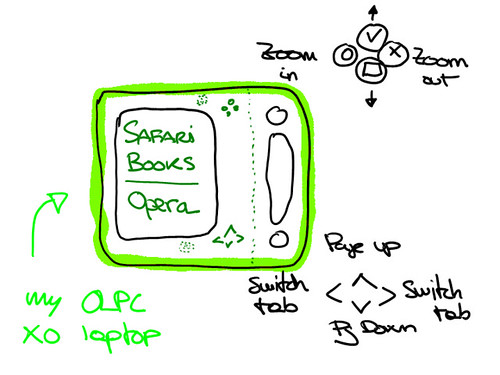
The arrow buttons in the game pad change whenever you change the screen orientation: up is always the one that points upwards. The playstation-like buttons do not change their function with the screen orientation.

Since all I want to do is read from already loaded tabs, these are the mappings that looked more comfortable for me. This other set would allow to use links and navigate.
Opera in handheld mode in my XO

ButtonNew valueApplication/Browser
o (PageUp)Zoom in,10Browser Widget
x (PageDown)Zoom out,10Browser Widget
[] (Home)Scroll downBrowser Widget
v (End)Scroll upBrowser Widget
UpPage upBrowser Widget
DownPage downBrowser Widget
LeftSwitch to previous pageApplication
RightSwitch to next pageApplication


To change the mappings, Tools -> Preferences -> Advanced Tab -> Shortcuts and edit the Keyboard setup named "Opera Standard for Unix"; you will be creating a modified version, and going back to the default one will be easy if needed. Search for them, and edit them with a double click, changing columns with the tab key. For the last two, you'll have to clear the search field, select the "Application" row and then click on "New..."

2009/11/13

Changes

Changes, changes, changes... Please, do not tell my mum about them, because she would be very upset with me!


Last July I took a two years leave from IBM. In a very smart move (in my opinion), IBM is paying me a third of my salary during a period that is forecasted to be of low business. I am allowed to work (and I need to!), but, obviously, I cannot work for IBM's competitors. They are investing this money to get a re-energized employee or, if the employee doesn't go back, to have him leave without having to lay him off, saving quite a bit of money.

I plan to take advantage of this by doing lots of learning and following some long time interests that I was performing on top of my formal role of at IBM: dealing/trying to make sense of organizations and teaching.

So what have I being doing during this months? Besides lots of reading and learning, Ganyet, Banzy and I toyed with the idea of working together in super-secret super-cool project, but, after a few weeks, I did not find a way to fit my skills into their needs; it is a pity, because world domination is in their road map.

When I left university, I should have made a project to become officially an engineer. I then joined IBM, and I was not disciplined enough to spend my free time finishing the project that I just started before joining. Almost 20 years later, I'm fixing that. And I'm very excited about it, because my project is about the software that should help to build a community around 1x1microcredit.org, a peer-to-peer micro-lending website that will offers people the possibility to lend money at low interest rates to poor people so that they can escape poverty, just like kiva.org. PHP aside, I feel very lucky for being able to work in a project that is technically cool and has an even cooler goal.

2009/11/12

"because" vs "in order to"

Charles Handy, in The Age Of Unreason

Continuous change is comfortable change. The past is then the guide to the future. An American friend, visiting Britain and Europe for the first time, wondered, "Why is it that over here whenever I ask the reason for anything, any institution or ceremony or set of rules, they always give me an historical answer, 'because'; whereas in my country we always want a functional answer, 'in order to'. Europeans, I suggested, look backward to the best of their history and change as little as they can; Americans look forward and want to change as much as they may.

I'll keep an eye opened to see what answers I give to myself, and what answers I hear from other people. Being an in-order-to person looks to me like a very nice goal.

2009/11/09

Peter Drucker: from supervision to objectives

Last post about the episode about Peter Drucker in The Handy Guide to the Gurus of Management.

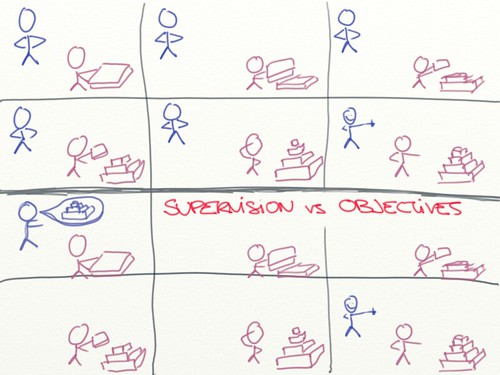
Peter Drucker: from supervision to objectives

Drucker later elaborated on the setting of objectives in Managing by Results and many have considered this to be his most important contribution to management thinking. He shifted the focus of management actions away from the inputs to the outputs. It was management by results rather than management by supervision.

(...) Management by Objectives can turn into management by targets and quotas, with workers spending more time chasing the numbers than doing the real work. (...) Drucker knew this. The measures had to measure what really mattered.
What Drucker wanted was a workplace where workers were trusted to get on with the job without undue supervision, where they knew what was expected of them and were clear about how it would be measured and how they would be rewarded.

2009/11/08

Peter Drucker on decentralization

Yet another post about the third episode in The Handy Guide to the Gurus of Management.
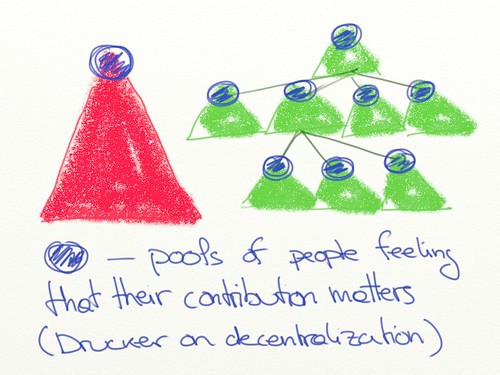
Peter Drucker on decentralization

He explained, for the first time, how and why decentralization worked. He calculated that 95 per cent of all decisions in General motors at that time were taken by the divisions, leaving only the really big ones for the centre. Drucker was keen on decentralization because of its impact on what he called Human Effort, the motivation it provided to people to work and to learn. Decentralization created small pools where people felt that their contribution mattered. Those small pools also meant that there was space for young executives to make mistakes without threatening the future of the company. They were, he said, farms for growing talent.

2009/11/07

Peter Drucker was there before

The third episode in The Handy Guide to the Gurus of Management, is about Peter Drucker. Now it's a nice time to learn a bit more about him, because right now Drucker's Centenial Week is happening: http://www.drucker100.com/, and some life webcasts will be on during this weekend.


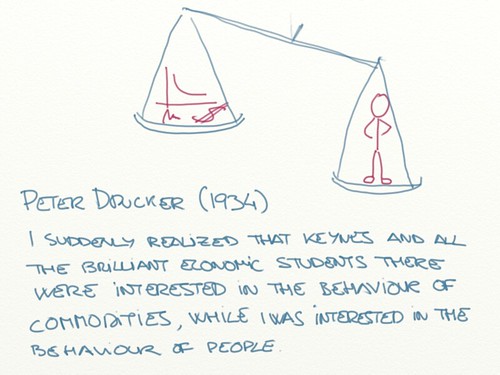
Peter Drucker: people vs commodities

I suddenly realized that Keynes and all the brilliant economic students there were interested in the behaviour of commodities, while I was interested in the behaviour of people.

2009/11/04

Charles Handy and Potfolio Lifes

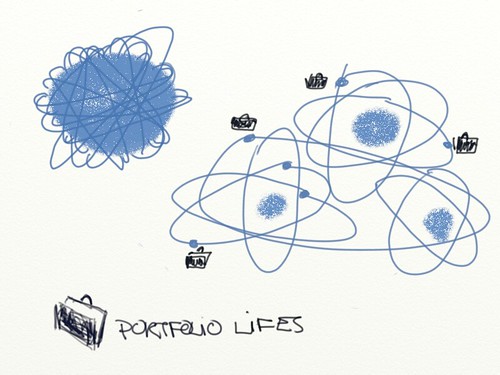
What interested me was not the downsizing or the re-engineering itself, but the consequences for our individual working lives. Organizations, it seemed to me, would increasingly dispense with our services in our mid-lives as they concentrated on fewer and younger people in their cores, with only a few wise heads to keep the show on track. The rest of us would have to develop what I called 'portfolio' lives, a mix of different bits and pieces of work, some for money, some for fun, some for free.

Portfolio Lifes
That quote was from Charles Handy, in the second episode of his Handy Guide to the Gurus of Management, hardly about management, but about society.

2009/11/03

The Handy Guide to the Gurus of Management

From BBC's Learning English, The Handy Guide to the Gurus of Management, an old (2002?) and delightful audio series.


Do not miss it.

It is written and narrated by Charles Handy. Listening to Handy's voice is a pleasure. And it does not matter if you don't care about businesses or management: most of it is about society and some of the changes in our world during the last half century.

Each episode is less than 15 minutes long, and has a full transcript.

Analyze your traffic without you

Even when you have like a dozen visits a day, checking google analytics now and then is nice (hey! a vsitor from Belize!). However, it is nice to be able to tell what traffic comes from yourself and what comes from your two readers (if any). A bookmarklet can help you to enable a filter that will allow analytics to remove you from its stats, or even to track your own usage of your site.

Update: bookmarklet magic moved from the defunct googlepages to amazon s3 to http://code.verg.es/sharebookmarklet.html

2009/10/07

Bonuses

Henry Mintzberg:

Executive compensation has become a polite form of thievery, or, if you prefer, legal corruption. Executives get paid extra when the stock price goes up (bonus) and when it goes down (golden parachute); they get paid extra for staying in their job (retention bonus (...)), and for just doing their job (a bonus for signing a merger (...)).

As for the argument that if you don’t pay the bonuses, you don’t get the right person, I counter that if you do pay the bonuses, you get the wrong person. You get someone who is willing to single him or herself out from everyone else, at the expense of teamwork (...). The CEO, like everyone else in the company, has a job to do and should be paid for doing it. (...)

For the sake of sustainable enterprise: Executive bonuses should be eliminated. Period.

From http://www.mintzberg.org/pdf/execbonus.pdf

2009/10/05

Once things have happened once

Charles Frankel, in High on Foggy Bottom; an Outsider's Inside View of the Government

Once things have happened, no matter how accidentally, they will be regarded as manifestations of an unchangeable Higher Reason. For every argument inside government that some jerry-built bureaucratic arrangement should be changed, there are usually twenty arguments to show that it rest's on God's own Logic, an that tampering with it will bring down the heavens.

Likely to be a valid statement also for individuals

2009/09/10

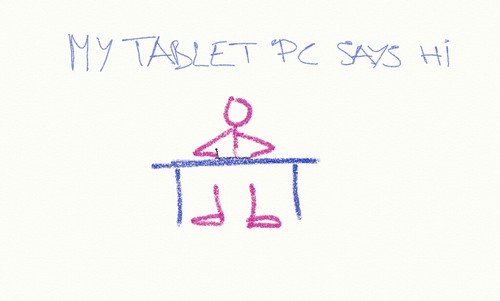
My tablet PC says hi

One of the joys of not being an Apple fanboy is that you can already be the user of a tablet PC. In case you are not aware of it, tablets are cool, comfortable and in a similar price range than any laptop.

My tablet pc says hi

In june I got an hp tx2000 at http://mcs-n.com and paid €712 for it. I took advantage of Plan Avanza's interest free credits.

It's small and easy to carry around; reading on it with its screen folded, either on the coach or in the bus, is very comfortable. Unfortunatelly, battery life is not that great; I'm hopping to extend it a bit by taking the time to undervolt its cpu.

It came preloaded with lots of crapware (dear HP, haven't you considered that maybe all this bloatware makes your hardware look bad and underperformant?). I wiped it and did a clean installation of Vista 64bits (make that two or three clean installations... damn activation!) Update: Before doing a clean install on a tablet pc, you may want to save some calibration data (something that I failed to do)

2009/06/11

Run!

cc'ing the world about something that a dear friend of mine should consider. From the New York Times: Exercise Found Effective Against Depression


Scientists at Duke University Medical Center tested exercise against the drug Zoloft and found the ability of either -- or a combination of the two -- to reduce or eliminate symptoms were about the same. But they found exercise seemed to do a better job of keeping symptoms from coming back after the depression lifted.
(...) 8 percent of exercisers saw symptoms come back, compared with 38 percent of those taking drugs and 31 percent getting both.
The studies do not prove exercise relieves depression, in part because the exercisers worked out in a group, so group dynamics may have played a role