2011/09/05

Preparativos para un Open Space

Vuelvo del Visual Management Open Space 2011 más feliz que un anís. Aunque con un pero. El mismo pero con el que volví del Agile Open Space 2011: hay muchas conversaciones interesantes que no llego a mantener por no conocer a buena parte de los asistentes.


¡Y eso que montamos una divertida red social unplugged (Gamestorming: Lo-Tech Social Network)!


Me gustaría que a la próxima reunión a la que asista llegue sabiendo algo de los asistentes a los que no he visto antes en mi vida. Me gustaría encontrarme buscando caras de algunas personas a las que no conozco pero a las que sé que quiero conocer.

Una posibilidad son las listas de twitter con los asistentes, como las que amablemente confeccionó David Bonilla antes del AOS2010 y del AOS2011 (e.g. http://twitter.com/david_bonilla/aos2011). Son útiles y facilitan los preparativos... pero están llenas de avatares irreconocibles, de nombres crípticos, de gente muda -sin twits, ni bio, ni ciudad-, de gente verborreica...

Otra posibilidad que me gusta más es hacer que los asistentes tengan que rellenar un "positioning paper" para registrarse. Se trata de un cuestionario mínimo en el que los asistentes explican algo sobre ellos, sobre qué esperan aportar a la reunión y sobre qué esperan sacar de ella. Al parecer, se trata de algo bastante común. En el Agile Coach Camp Norway 2011, nos hicieron rellenar uno, y a mi resultó muy útil.

Como ventaja adicional, esto hace que el coste del registro sea mayor que un simple click, lo que hace más improbable que la gente se apunte demasiado a la ligera y deje a alguien más interesado sin plaza.


2011/04/12

Are we unprofessional?

From Uncle Bob's Clean Code, discussing the pressures that professionals get to deliver unacceptable quality:

What if you were a doctor and had a patient who demanded that you stop all the silly hand-washing in preparation for surgery because it was taking too much time? Clearly the patient is the boss; and yet the doctor should absolutely refuse to comply. Why? Because the doctor knows more than the patient about the risks of disease and infection. It would be unprofessional for the doctor to comply with the patient.

Ouch! What a great metaphor! It really hurts, but it is also a brilliant invitation to get vocal when one needs to get vocal.

2011/03/26

Els ciclistes opinen

El 2011 he agafat la bicicleta UN dia. I resulta que aquell dia, a un carril bici de la Diagonal, unes noies em fan una pregunta, unes fotos, i em demanen autorització per publicar-la al Barcelona Informació que l'ajuntament reparteix a totes les cases.


Jo no els vaig dir a aquelles noies tan amables que cada cop anés més amb bici, doncs fa uns anys que gairebé no hi vaig mai. Si que els vaig dir que em sembla que cada cop hi ha més carrils bici, tot i que el meu amic David i la seva Brompton blau cel ho neguin amb indignació.


De tota manera, no em sembla malament que l'ajuntament em faci quedar com un gran esportista.

2010/11/11

Tú tienes cáncer y yo no

Cada vez que te encuentres pensando o diciéndole a alguien "qué putada" o "qué mala suerte", acuérdate de los mineros de Chile. Supongo que los habrá que estarán diciendose "qué mala suerte haber tenido que pasar un montón de tiempo enterrado sin saber si me iba a salvar". Pero también los habrá que pensarán que han tenido una suerte enorme de ser rescatados y estar fuera. Está claro cuál de los dos grupos siente mayor bienestar, ¿no?

Indudablemente, te vendrá mil veces a la cabeza el "qué putada". ¡Claro, es que es una putada! ¡Tú tienes cáncer y yo no! Ni tampoco aquel, ni aquel otro, ni el de más allá... Pero cada vez que te recrees en un "qué putada", estarás generando un determinado tipo de adrenalina que hará que todavía te sientas más ansiedad y con más ganas de recrearte en el "qué putada".

Por eso, cada vez que te venga a la cabeza un "qué putada", has de construirte un discurso como el de los mineros contentos. ¿Qué mala suerte: tengo cáncer? ¡Qué suerte! ¡Me lo han detectado a tiempo y voy a salir de esta! ¿Qué mala suerte: me han encontrado otro bulto? ¡Qué suerte! ¡Ha estado a punto de pasarles por alto y luego habría sido todo más complicado! En muchísimos casos, hacer una lectura en clave de buena suerte es razonable.

Y eso no es engañarse. ¿Tú crees que alguien pensaría de un minero de Chile que se sienta afortunado que se está engañando? ¡Que no me vengan con tonterías de que un pesimista es un optimista bien informado! ¡Un minero de Chile que tenga un discurso de "qué mala suerte" es simplemente un amargado, no alguien que no se engaña a si mismo!

Si sabes hacerlo, si sabes acordarte de los mineros cada vez que estés con lo de "qué putada", si sabes construir un discurso de sentirte afortunada, te sentirás mejor, te curarás antes y recibirás de la gente miradas de admiración (¡qué entereza tiene esta chica!), bastante más gratificantes que las miradas de compasión. Si te dejas llevar por el camino del "qué putada", cada paso de tratamiento será una nueva putada; objetivamente, seguro de que no habrá ni uno que sea un plato de buen gusto. Pero si sabes construir un discurso de "qué suerte", cada paso será un avance en estar curada, un nuevo motivo para sentirse afortunada a pesar del engorro.

O sea que, por fin, después de tantos años, no me vengas más con qué-putadas, qué-mala-suertes y qué-temporaditas. A partir de ahora solo quiero buenas noticias.

Un abrazo.
-Xavier

2010/11/09

Kids need to learn to make good choices

You know, kids learn to make good choices not by following directions but by making choices
I liked this sentence so much that I wanted to find out more about its author, Alfie Kohn. After reading several reviews, good and bad, at Amazon, I ended up ordering Unconditional Parenting and making worse the backlog of books on my table.

While skimming over its intro, I liked a fragment by Barbara Coloso, on teenagers whose parents complain 'he was such a good kid, so well behaved, so well mannered, so well dressed. Now look at him!':

From the time he was young, he dressed the way you told him to dress; he acted the way you told him to act; he said the things you told him to say. He's been listening to somebody else tell him what to do... He hasn't changed. He is still listening to somebody else tell him what to do. The problem is, it isn't you anymore; its his peers.

2010/10/28

La paciencia tiene un límite


Al parecer, el catalán ya no puede ser el idioma preferente en el ayuntamiento de la capital de Cataluña.

Nos están echando. Y me sabe fatal.

2010/10/06

Hábitos de estudio

He encontrado un buen artículo (en el New York Times) que habla de hábitos de estudio y se carga algunas cosas que hemos dado por supuestas toda la vida.

Jóvenes lectores, préstenme su atención, por favor.

El repaso
  • Repasar a menudo. La empollada del día antes del examen, nos sirve (con suerte) para el examen, pero, el curso siguiente ¡ni recordaremos que lo hemos estudiado! Repasar más de una vez el mismo material, lo va asentando.
  • Al repasar, empezar preguntándonos lo que recordamos antes de ponernos a releer libros o apuntes. Conviene hacerse exámenes, o escribir un esquema con lo que recordamos del tema, porque, recuperar una información de nuestra cabeza hace que se vuelva más difícil de olvidar. Esto me daba muy buen resultado en la carrera, y ¡debería volver a practicarlo!
Alternar el lugar de estudio
  • A diferencia de las recomendaciones habituales, alternar el lugar de estudio y estudiar en lugares en los que hay una variedad de estímulos sensoriales (una ventana o ¡una mesa desordenada!), es más efectivo que estudiar siempre en el mismo sitio. Al parecer, los estímulos podrían "enriquecer" la información y provocar que la olvidemos más despacio.
  • ¡OJO! No confundir "estimulos sensoriales" con estar en multitarea o tener encendido el messenger, el facebook y la tele: hay estudios que demuestran que el estar por más de una cosa a la vez nos hace menos efectivos.
Alternar el trabajo de distintas habilidades
  • Ejercitar distintas habilidades en una sola sesión de estudio mejora la retención. Por ejemplo,
    • con un idioma, trabajar vocabulario, lectura y pronunciación en cada sesión de estudio.
    • si en Historia del Arte estudiamos 12 pintores, aprenderemos a reconocer mejor sus obras, si las vamos viendo mezcladas que si vemos primero las de un pintor, luego las de otro, y otro...
  • Sea porque el cerebro está más contento por la ausencia de monotonía, sea porque le damos más herramientas para comparar y reconocer patrones, el aprendizaje es más duradero.

2010/10/05

I have been reading

I have not been posting in months, but I have been reading some books.

I have also added some watercolor-painted stick-figure icons to http://els.verg.es/xavier, that has links to some of the different pieces of my digital identity.

2010/05/18

OpenID

I'm a happy new user of http://myopenid.com.
  • Registration was very simple
  • The OpenID urls you get are nice (yourchoice.myopenid.com)
  • It supports multiple personas, i.e. during the signon process, you can choose differents sets of personal information to share with the requesting site
  • You get a detailed account activity report
Out of laziness, I've been resisting for years to get a proper OpenID account. Sometimes I've been using the one provided with blogger.com; others, my Flickr photostream url. And then sometimes I've signed up to places using my google or twitter accounts. In fact, a site requesting access to my list of contacts during registration with my google account has been the trigger to take care of this.

Two html lines have allowed me to use a vanity url (http://els.verg.es/xavier) and to avoid getting married to myopenid.com

2010/02/19

Secretaries

Expect to see personal assistants whose primary job is to sift through information and eliminate unnecessary drains on high-powered knowledge workers' attention (perhaps we will call them "secretaries").
As far as I'm aware, we haven't reached that point yet, and most business still value more cost-cutting on support staff than having people waste their attention in business logistics. Does not look that diffused complexity is planning to go away any time soon.

2010/02/07

Acelerador sensible y malos frenos

He leído un artículo estupendo sobre cómo los adolescentes gestionan el riesgo: No Brakes! Risk and the adolescent brain. Lo resumo para mis amistades perezosas o poco amigas del inglés, pero recomiendo la lectura del original. Es más, recomiendo la subscripción a la sección de familia de Slate.

Thailand Drunk Driving
Thailand Drunk Driving by nathansnostalgia, on Flickr
Los adolescentes son como coches con un acelerador muy sensible y unos frenos de chichinabo. No es que sean incapaces de entender que una conducta es de riesgo, sino que, simplemente, esta puede parecerles la opción correcta. La presencia de otros adolescentes aumenta el atractivo de la conducta arriesgada; esto es así tanto si están jugando a un videojuego, en el que conducirán o matarán marcianos de manera más temeraria, como si se enfrentan a un "simplemente di no", a un "póntelo-pónselo" o a un volante o un manillar de verdad.

Los sermones familiares y las campañas de prevención parten de la base de que los adolescentes no entienden los riesgos y se hace necesario explicárselos; en la mayoría de los casos, los entienden perfectamente, y por ello sermones y campañas tienen un efecto mínimo.

Al parecer, ciertas dosis de riesgo son sanas. Sin embargo, los adolescentes que son grandes amantes del riesgo y no se matan por el camino, tienen probabilidades más elevadas que la media de un futuro feo y conflictivo. Y, oh sorpresa, también los adolescentes alérgicos al riesgo.

Afortunadamente, el amor al riesgo se cura con el tiempo. Se va incrementando desde los diez años, suele tener un pico hacia los 15 ó 16, y se estabiliza hacia los veinte. En la fase descendente, las conductas de riesgo suelen ser más individuales y menos de pandilla.

Además de cruzar los dedos y esperar a que lleguen enteros a los veinte, ¿pueden hacer algo los padres? El segundo artículo de la serie da algunos consejos.

  • Como ya sabían las abuelas de nuestras abuelas, ¡cuidado con las malas compañías!
  • Cuanto más tarden empiecen, mejor, y despistar no es mala idea ¡Vamos otra vez de compras!
  • Vigilancia/control. Si es posible, llegar a la adolescencia habiendo creado una atmósfera en la que padres e hijos se cuentan mútuamente qué hacen durante el día y con quién.
  • Valores convencionales. Hay menos conductas arriesgadas en aquellos chicos de familias en las que se valora el esfuerzo, el aprendizaje escolar, la figura del profesor, la lectura... y en las que se hacen cosas juntos a menudo.
  • Desarrollar alguna habilidad, especialmente si puede utilizarse durante la adolescencia y con otros compañeros: practicar un deporte, tocar un instrumento, tener un hobby...
  • Tener una buena relación. Los chicos que valoran bien la relación con sus padres tienen menor tendencia a las conductas de riesgo. Los hijos de padres demasiado permisivos o demasiado autoritarios tienen más probabilidades de caer en conductas antisociales.

Me gusta el penúltimo párrafo del artículo:
Los padres a menudo se sienten presionados por una resbaladiza lógica que les dice que "si dejo pasar esta, perderé el control y mi hijo se convertirá en un bárbaro", pero esto es lo contrario de lo que suele pasar.
Monta un batalla sobre cada pequeña cosa y perderás tanto las batallas como la gran guerra. Y la metáfora sobre perder batallas y ganar la guerra es poco acertada porque arranca poniéndote en contra de tu hijo.
Una metáfora mejor: diriges un barco hacia el objetivo de convertir a tu hijo en un adulto competente, bien ajustado y no aprovechón; ese objetivo requiere navegar haciendo bordos en zig-zag, aunque a veces parezca que nos alejamos de él.
¡Espero que la singladuras que me tocan no sean muy complicadas!

2009/11/30

Carrots & Sticks? Autonomy, Mastery, Purpose

Fun and surprising TED Talk by Dan Pink on Motivation.


Experiments show that extrinsic motivators (carrots and sticks) work great for simple/mechanical-like tasks, probably by providing a narrow focus. But... rewards make performance worse for creative/complex tasks!!!

Cartoon by Nathalie 0Magniez
It's a funny coincidence that today I picked up a free copy of the The Wall Street Journal and it had an article on executive bonuses. Huge expensive carrots that, according to the experiments above, lead to less ability to deal with complexity.

2009/11/25

Using OLPC XO as an ebook reader for O’Reilly’s Safari Books Online

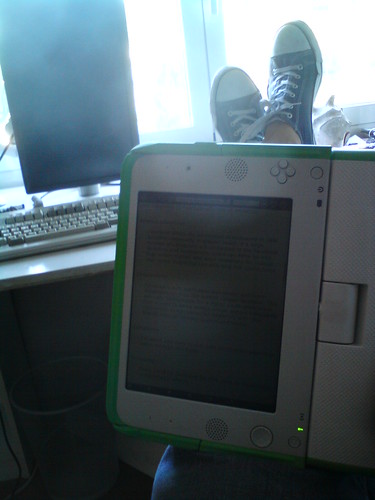
My XO OLPC is not collecting dust any more after I suddenly realized that its reflective screen mode would allow me to read safaribooksonline.com while outside. Firefox is an option, but I went for Opera. While connected, I open in different tabs the sections that I'm going to read; I then read in handheld mode, with wifi turned off to have a longer batery life.


My XO, my feet. my window, my IBM keyboard and my awesome monitor
  1. I updated my XO from how it came from the first edition of G1G1. The updated version is more friendly and privides a much longer battery life.
  2. Installed the old OLPC build of Opera.
  3. I tried to change (to no effect) the tiny tiny menu fonts (Tools -> Preferences -> Advanced Tab -> Fonts -> Interface Menu. Choose DejaVu serif, increase font to 16 and select bold for the weight. Setting the Interface menu font to anything greater than 16 causes menu text to become unreadable)
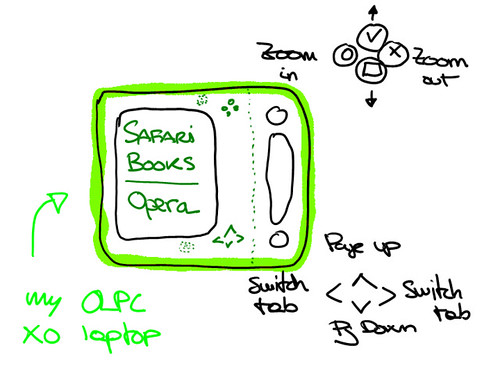
  4. I remapped the game pad buttons (more on this later)
  5. I went to http://www.safaribooksonline.com/interim/ that provides access to the mobile interface from non-mobile devices. Note the "interim" in the url: they did not allow this until recently, when a change from html to flash annoyed lots of customers; who knows for how long this will be available.

The arrow buttons in the game pad change whenever you change the screen orientation: up is always the one that points upwards. The playstation-like buttons do not change their function with the screen orientation.

Since all I want to do is read from already loaded tabs, these are the mappings that looked more comfortable for me. This other set would allow to use links and navigate.
Opera in handheld mode in my XO

ButtonNew valueApplication/Browser
o (PageUp)Zoom in,10Browser Widget
x (PageDown)Zoom out,10Browser Widget
[] (Home)Scroll downBrowser Widget
v (End)Scroll upBrowser Widget
UpPage upBrowser Widget
DownPage downBrowser Widget
LeftSwitch to previous pageApplication
RightSwitch to next pageApplication


To change the mappings, Tools -> Preferences -> Advanced Tab -> Shortcuts and edit the Keyboard setup named "Opera Standard for Unix"; you will be creating a modified version, and going back to the default one will be easy if needed. Search for them, and edit them with a double click, changing columns with the tab key. For the last two, you'll have to clear the search field, select the "Application" row and then click on "New..."

2009/11/13

Changes

Changes, changes, changes... Please, do not tell my mum about them, because she would be very upset with me!


Last July I took a two years leave from IBM. In a very smart move (in my opinion), IBM is paying me a third of my salary during a period that is forecasted to be of low business. I am allowed to work (and I need to!), but, obviously, I cannot work for IBM's competitors. They are investing this money to get a re-energized employee or, if the employee doesn't go back, to have him leave without having to lay him off, saving quite a bit of money.

I plan to take advantage of this by doing lots of learning and following some long time interests that I was performing on top of my formal role of at IBM: dealing/trying to make sense of organizations and teaching.

So what have I being doing during this months? Besides lots of reading and learning, Ganyet, Banzy and I toyed with the idea of working together in super-secret super-cool project, but, after a few weeks, I did not find a way to fit my skills into their needs; it is a pity, because world domination is in their road map.

When I left university, I should have made a project to become officially an engineer. I then joined IBM, and I was not disciplined enough to spend my free time finishing the project that I just started before joining. Almost 20 years later, I'm fixing that. And I'm very excited about it, because my project is about the software that should help to build a community around 1x1microcredit.org, a peer-to-peer micro-lending website that will offers people the possibility to lend money at low interest rates to poor people so that they can escape poverty, just like kiva.org. PHP aside, I feel very lucky for being able to work in a project that is technically cool and has an even cooler goal.

2009/11/12

"because" vs "in order to"

Charles Handy, in The Age Of Unreason

Continuous change is comfortable change. The past is then the guide to the future. An American friend, visiting Britain and Europe for the first time, wondered, "Why is it that over here whenever I ask the reason for anything, any institution or ceremony or set of rules, they always give me an historical answer, 'because'; whereas in my country we always want a functional answer, 'in order to'. Europeans, I suggested, look backward to the best of their history and change as little as they can; Americans look forward and want to change as much as they may.

I'll keep an eye opened to see what answers I give to myself, and what answers I hear from other people. Being an in-order-to person looks to me like a very nice goal.

2009/11/09

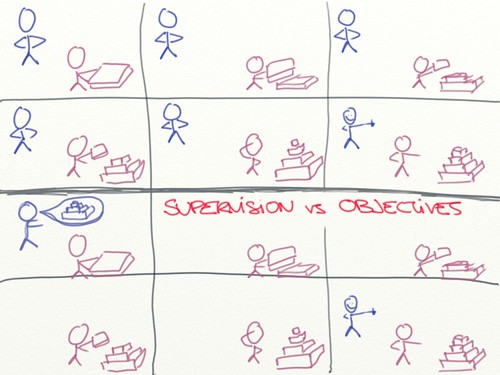
Peter Drucker: from supervision to objectives

Last post about the episode about Peter Drucker in The Handy Guide to the Gurus of Management.

Peter Drucker: from supervision to objectives

Drucker later elaborated on the setting of objectives in Managing by Results and many have considered this to be his most important contribution to management thinking. He shifted the focus of management actions away from the inputs to the outputs. It was management by results rather than management by supervision.

(...) Management by Objectives can turn into management by targets and quotas, with workers spending more time chasing the numbers than doing the real work. (...) Drucker knew this. The measures had to measure what really mattered.
What Drucker wanted was a workplace where workers were trusted to get on with the job without undue supervision, where they knew what was expected of them and were clear about how it would be measured and how they would be rewarded.

2009/11/08

Peter Drucker on decentralization

Yet another post about the third episode in The Handy Guide to the Gurus of Management.
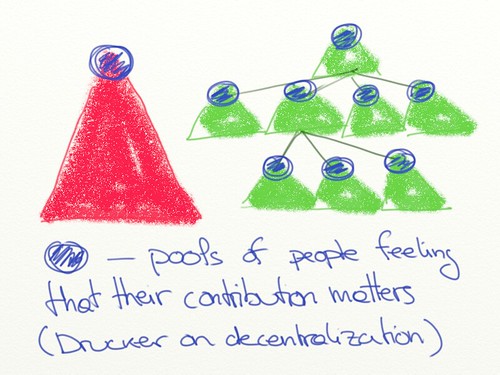
Peter Drucker on decentralization

He explained, for the first time, how and why decentralization worked. He calculated that 95 per cent of all decisions in General motors at that time were taken by the divisions, leaving only the really big ones for the centre. Drucker was keen on decentralization because of its impact on what he called Human Effort, the motivation it provided to people to work and to learn. Decentralization created small pools where people felt that their contribution mattered. Those small pools also meant that there was space for young executives to make mistakes without threatening the future of the company. They were, he said, farms for growing talent.

2009/11/07

Peter Drucker was there before

The third episode in The Handy Guide to the Gurus of Management, is about Peter Drucker. Now it's a nice time to learn a bit more about him, because right now Drucker's Centenial Week is happening: http://www.drucker100.com/, and some life webcasts will be on during this weekend.


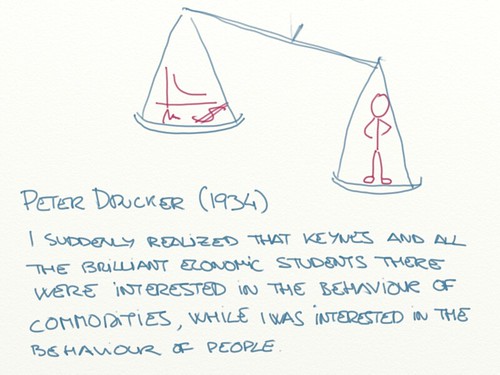
Peter Drucker: people vs commodities

I suddenly realized that Keynes and all the brilliant economic students there were interested in the behaviour of commodities, while I was interested in the behaviour of people.

2009/11/04

Charles Handy and Potfolio Lifes

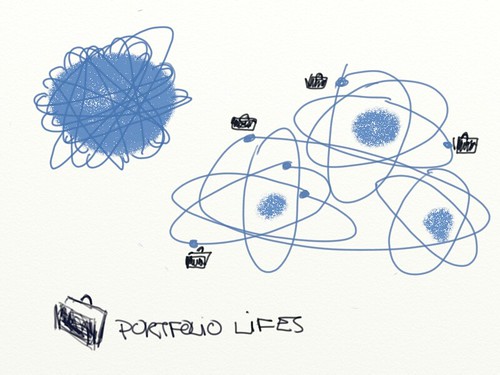
What interested me was not the downsizing or the re-engineering itself, but the consequences for our individual working lives. Organizations, it seemed to me, would increasingly dispense with our services in our mid-lives as they concentrated on fewer and younger people in their cores, with only a few wise heads to keep the show on track. The rest of us would have to develop what I called 'portfolio' lives, a mix of different bits and pieces of work, some for money, some for fun, some for free.

Portfolio Lifes
That quote was from Charles Handy, in the second episode of his Handy Guide to the Gurus of Management, hardly about management, but about society.

2009/11/03

The Handy Guide to the Gurus of Management

From BBC's Learning English, The Handy Guide to the Gurus of Management, an old (2002?) and delightful audio series.


Do not miss it.

It is written and narrated by Charles Handy. Listening to Handy's voice is a pleasure. And it does not matter if you don't care about businesses or management: most of it is about society and some of the changes in our world during the last half century.

Each episode is less than 15 minutes long, and has a full transcript.